Practice With the Sibling in Tow: The Sideline Bag Plan
Bringing a sibling to sports practice works when you stop improvising it: a dedicated sideline bag that only appears at the field, an assigned “spot” that marks their territory, snacks deployed on schedule rather than on demand, and a hard eye on the clock when practice runs past a preschooler’s evening. That’s the whole system. The five-year-old who melts down at week four’s practice isn’t a difficult kid — he’s a kid attending ninety minutes of someone else’s activity with no plan built for him, twice a week, at the exact hour his battery dies.
The sideline bag: novelty is the whole technology
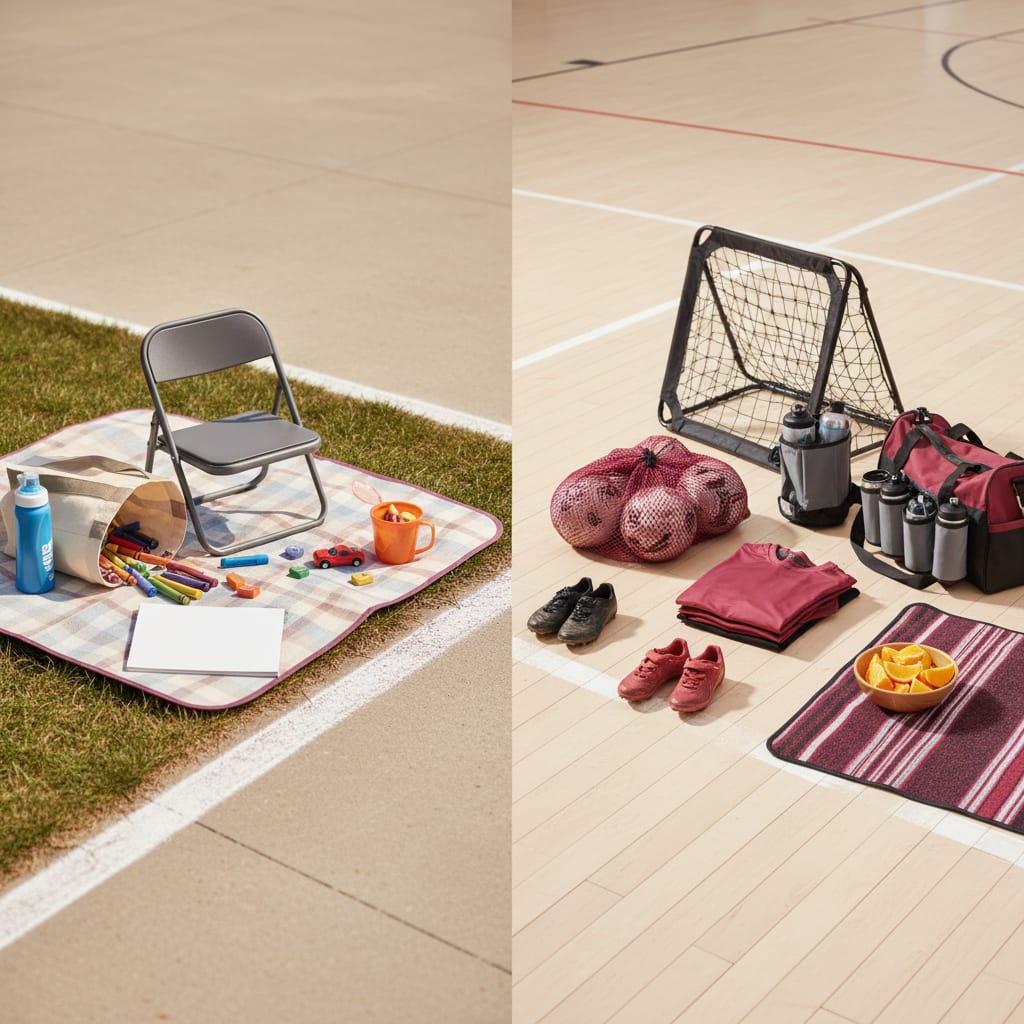
The engine of the system is one bag, packed for the sibling, governed by a single rule: it only exists at the field. The same toys that are wallpaper at home are interesting again at the sideline, precisely because they live in exile between practices. Rotate the contents every few weeks and the bag stays interesting all season; let the bag migrate into the house and it dies within a week. I’ve run this protocol through two younger siblings and the finding replicates.
What goes in: a few small vehicles or figures, crayons and a pad, a sticker book like the Melissa & Doug reusable sticker pads, one surprise item from the dollar bin. What earns the roster spot is independent play value — this is a bag for alongside-you time, not a bag that needs a facilitator, because you’ll be half-watching a scrimmage. For genuinely fresh ideas by age, the activity-listicle library at Best Toddler Tips is the deep bench I raid before every season; curating that genre is their whole sport, not mine.
What stays home: anything with more than three parts, anything beloved-and-losable, and at twilight practices, anything grass-colored. Ask me how I know.
Territory: the blanket is a border
Assign a spot. A picnic blanket or a small camp chair of their own isn’t comfort gear — it’s a boundary a small kid can actually see: this is your bench. A sibling with defined territory wanders onto the pitch measurably less than one orbiting a standing parent, and when they do drift, “back to your blanket” is a namable place rather than an argument.
Set the blanket up with sightlines — close enough to the action that they can watch their big sister be briefly glorious (that’s half the point of being dragged here; make sure it’s available), far enough from the goal line that a stray ball isn’t part of the evening.
Snacks are a schedule, not a response
The rookie error is treating snacks as a meltdown-response tool, which trains a very quick learner to produce meltdowns on cue. Run it as a fixed ritual instead: one snack when the bag opens, the real one — a substantial, dinner-adjacent one at evening practice — at the halfway mark. Same order every time; the predictability is doing more work than the crackers. (Note the lane line: what to feed the team is Hey Mom Blog’s beat. This is just the sideline timing doctrine.)
The bedtime problem: the part that isn’t about the bag
Here’s the honest limit of every trick above: a 6:30–8:00 practice has a five-year-old out an hour past wind-down twice a week, and no sticker book fixes that. The endgame of the meltdown isn’t boredom — it’s a kid who should be in pajamas. That deserves its own plan, and it has one: the full evening-practice bedtime playbook covers picking sleep-friendly practice slots and running the wind-down at the field.
The bag plan and the bedtime plan are one system, and the hinge between them is knowing what tonight’s bedtime even should be once the schedule’s wobbling. When we hit that wall with our youngest, Betteroo’s quiz-built sleep plan is what settled the nightly debate — it hands you the day-by-day call for your littlest, which turns “we’ll deal with it at home” into an actual landing sequence. A tool, not magic; but on Tuesdays, a load-bearing tool.
The escalation ladder (for the night it all fails)
Some practices, the bag is boring, the blanket is lava, and the kid is done at minute twenty. In order:
- The job. Small kids will decline entertainment but accept employment: water-bottle guardian, cone collector after drills, official waver-to-the-sister. Status beats stickers.
- The walk. One lap of the field perimeter, holding hands, narrating dogs. Resets the clock by fifteen minutes, reliably.
- The car. Not a defeat — a venue change: audiobook, dome light, blanket. Practice can be heard from the parking lot, and a contained cozy kid beats a shredded sideline one.
- The bail. If it’s a two-adult night or a carpool’s available, leaving early with the little one is a professional decision, not a forfeit. Veterans bail smug, not sheepish.
FAQ: siblings at practice
How do I keep a toddler entertained at their sibling’s practice?
A field-only bag of independent toys, an assigned blanket-territory with a view of the action, scheduled snacks, and a job title when all else fails. Rotate the bag’s contents every few weeks — exile between practices is what keeps it working.
Should I just get a sitter instead of bringing the sibling?
If it’s cheap and easy, twice a season, on the brutal-weather nights — sure. But most families can’t staff every practice, and the sideline sibling routine has real returns: the little one learns to be part of someone else’s moment, which is an underrated life skill with a long career ahead of it.
What about screens at the sideline?
Zero judgment here — a tablet on the worst nights is a tool like any other. The only caution is order of operations: deploy it as the final tier, not the opening move, or it becomes the only currency the sideline accepts, and the bag never works again.
The sibling keeps running onto the field. What actually works?
Visible territory (the blanket), proximity to you (arm’s reach at first), and a pre-practice script: “players on the grass, fans on the blanket.” Then relentless, boring consistency — walked back every single time. The wander peaks around week three and fades once the territory habit sets, provided the border never moves.