How to Teach a Kid to Throw a Baseball (Step by Step)
To teach a kid to throw a baseball, build it in the order Little League’s own coaching plans use: the grip first, then throwing from one knee, then standing sideways with the glove shoulder pointed at the target, then the step with the opposite foot, then the follow-through. Keep the distance short, use a soft ball, and give them a target they can see. Two cues carry almost all of it: “step to your target” and “thumb to thigh, show it to the sky.” Ten-minute sessions, three times a week, beat a long Saturday.
This is the twin of teaching a kid to catch, and the two belong in the same backyard session. A kid who can catch but not throw ends up standing still while a parent chases every return.
Why most kids throw “wrong” at first
Watch a five-year-old throw and you will usually see the same picture. Feet square to the target, the ball pushed from the ear like a dart, the same-side foot stepping forward, and the arm stopping the instant the ball leaves the hand. None of that is a flaw. It is just the throw a body does before anyone shows it the other one.
The fix is not a long explanation. Young players drown in instructions. The fix is to break the throw into pieces small enough to get right one at a time, and to give each piece a name the kid can say back.
Step 1: the grip
Little League’s Tee Ball Program plan for week two gives the grip in one line: “fingers on top with thumb underneath,” with grip pressure “like holding a tube of toothpaste.” That second phrase is the best coaching cue on this page. Squeezed too hard, the ball comes out late and into the dirt.
Its coach-pitch plans then move older players onto a four-seam grip, and the week-four plan has coaches “show players two-and three-finger grips.” Small hands use three fingers. Do not fight that.
The drill: scatter a dozen balls in the grass. On “go,” the kid picks one up and shows you the grip without looking at their hand. Pick up, grip, show. Thirty seconds of this does more than five minutes of you adjusting their fingers.
Step 2: throw from one knee
Little League’s coach-pitch plan for week three has players “take a knee and throw to each other.” Kneeling on the throwing-side knee removes the legs from the problem entirely, so the kid can work on just the arm and the release.
Stand eight to ten feet away, hold your glove up as a two-hand target, and play catch from the knee. The coach-pitch plan has a rule worth borrowing word for word: “Do not throw until you see a two-hand target.” It slows everyone down and gives the throw a place to go.
Step 3: stand sideways
Now stand them up, but turned sideways: glove-side shoulder pointing at the target, feet in a line toward it. The week-four plan lists “shoulder-to-partner” among its five steps of throwing, between the step and the launch. A kid who is turned sideways has room to rotate through the throw. A kid square to the target has to push.
The cheapest cue for this is to have them point the glove hand at you before every throw. If the glove points at you, the shoulder does too.
Step 4: the step
This is the piece that takes longest, so expect the regression. Little League’s week-two goal is that players can “throw overhand stepping with opposite foot,” and the same plan starts practice by having players “raise their throwing hand and touch their stepping foot with that hand.” Do that exact check in the yard. A right-handed thrower steps with the left foot, toward the target.
The cue is “step to your target.” A step that goes sideways sends the ball sideways.
Step 5: the arm path and the finish
Little League’s tee ball plan describes the arm in one rhyme: as the ball comes out of the glove, “thumb to thigh, show it to the sky.” The hand swings down past the thigh and up, ball facing the sky, before it comes forward. Then the follow-through: the plan says to let the arm “continue to move” after release, because “stressing this follow through will prevent them from stopping their arm as soon as they release the ball.”
A simple finish check: the throwing arm should carry on across the body after release. If it stops at the ear, that is the dart throw coming back.
Step 6: add distance, one step at a time
Same rule as catching. Move back one big step after five good throws in a row; come in after two bad ones. The distance is not the point. The good rep is.
The hoop target: the drill kids ask for
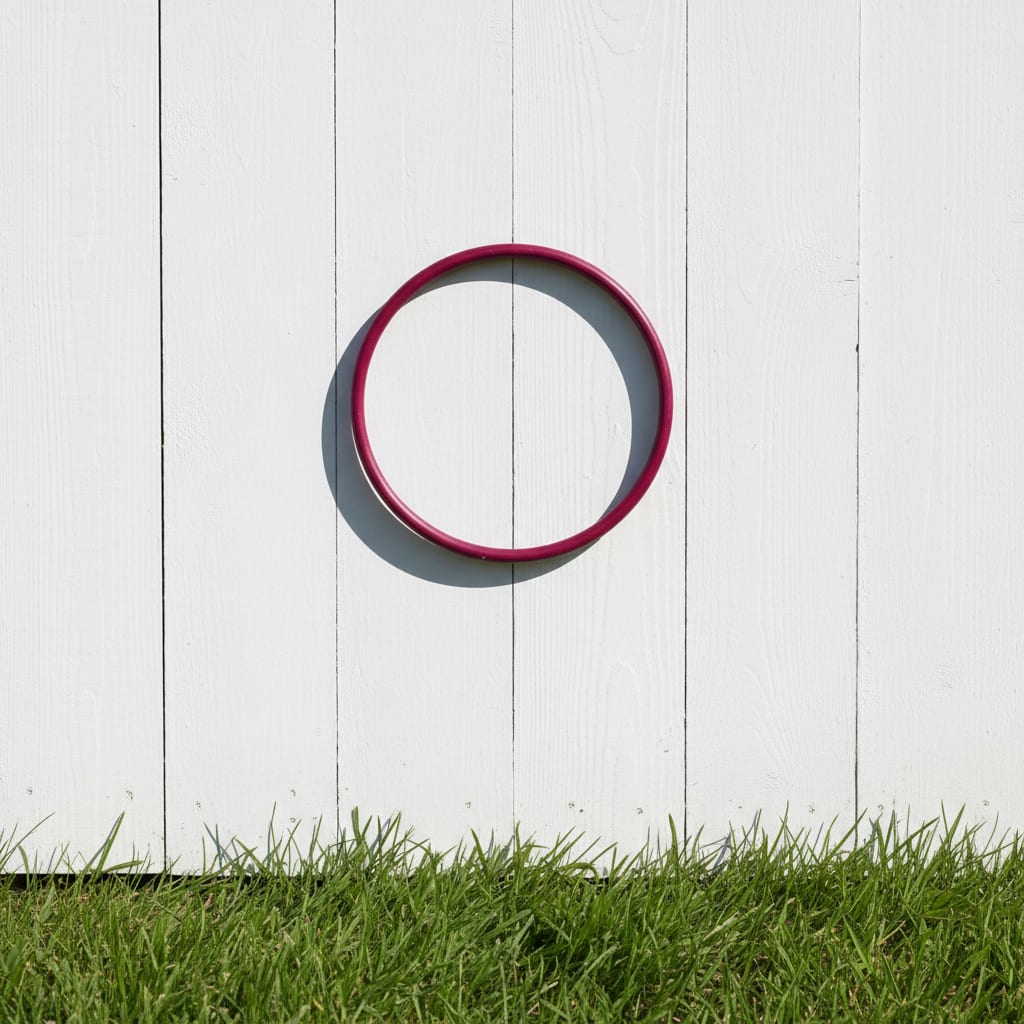
Little League’s week-two plan hangs “3 to 4 hula hoops at player-throwing height on the fence,” about ten feet apart, and every throw through a hoop counts as an out. In a backyard, one hoop zip-tied to a fence or hung from a tree branch does the same job. Kids will throw at a hoop for far longer than they will throw at a parent.
Ball choice matters as much as target. A soft ball means a miss off the fence or a sibling is not a disaster, and kids throw more freely when nothing can break. Franklin Sports Soft Strike Teeballs are the soft ball I hand families for the first season of this. Move to a real baseball once the throw is reliably reaching the target.
The ten-minute session
- Two minutes of grip pick-ups. The warm-up is the grip, not stretching.
- Three minutes from the knee. Ten good throws to a two-hand target.
- Four minutes standing, with the step. Count out loud. Back a step after five in a row.
- One minute of hoop outs. Three outs and you are done.
Stop while they still want more. The habit side of that, which matters more than any drill, is in the ten-minute practice habit. Pair it with five minutes of catching and you have the whole backyard session.
What stalls a kid (all adult errors)
Teaching all five steps at once. Pick one piece per week.
Backing up too fast. Distance before the step is learned brings the dart throw straight back.
Correcting every throw. Say the number, praise the good one, ignore the bad one, feed the next ball.
Turning throwing into pitching. Pitching is a separate skill with its own league rules and its own coaches. This page is about throwing. Anything about arms, elbows or shoulders goes to the coach or the pediatrician, never to the backyard.
FAQ: teaching a child to throw a baseball
What age can a kid learn to throw a baseball?
Little League’s tee ball division runs from ages 4 to 7, and throwing overhand with the step is a week-two goal in its tee ball plan. Most kids can start the grip and the throw from a knee in that range. The spread is wide and normal.
How do I stop my child stepping with the wrong foot?
Use Little League’s check: raise the throwing hand, touch the stepping foot with it, then step with that foot toward the target. Repeat it before every throw until it is automatic.
Should my child throw with two fingers or three?
Little League’s coach-pitch plans show both two- and three-finger grips. Small hands use three. They will move to two as their hands grow.
What ball should I use to teach throwing?
A soft tee ball for the first season, so misses cost nothing. Move to a regulation youth baseball when the throw reliably reaches the target.
How far apart should we stand?
Start about eight to ten feet apart, from a knee. Add one step after five good throws in a row and come back in after two misses.