What to Say After the Game (Win, Lose, or Benched)
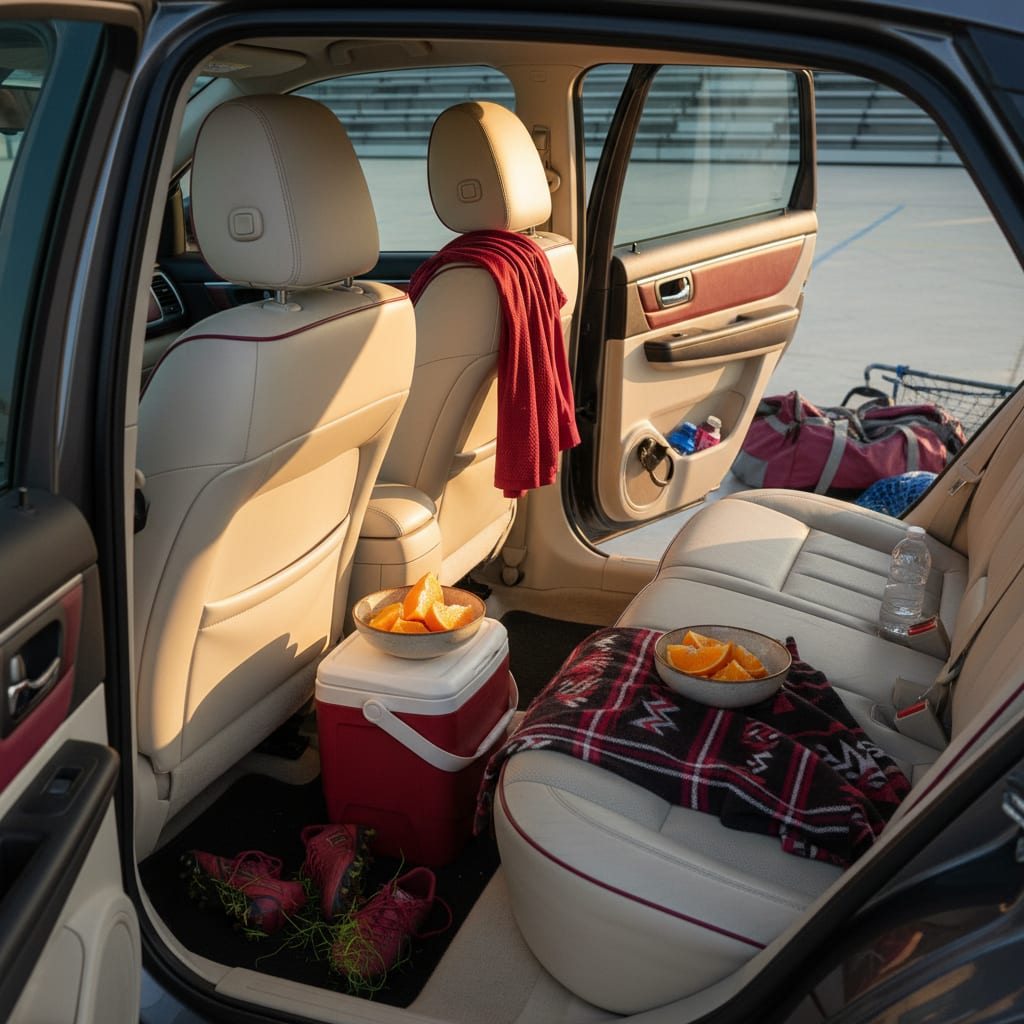
The answer is six words: “I love watching you play.” Say it, hand over food, and stop talking. That’s the whole script, and it works after a win, after a blowout loss, after the game your kid spent on the bench, and after the one where they scored on their own goal. Everything else — the analysis, the encouragement, the “you know what would’ve helped” — belongs to someone else or to nobody. The postgame car is not a film room, and your kid already knows how they played.
Why the debrief backfires
Here’s the thing that took me two seasons to accept: a kid coming off a field is not in a state to receive coaching. They are hot, hungry, over-stimulated, and running a private replay of the worst thirty seconds of their afternoon. Into that, a parent offers “you were great, but next time try to stay wide” — and the kid hears exactly one word of that sentence, and it isn’t “great.”
The other cost is subtler. When every game ends in analysis, the kid learns that playing is a thing they will be assessed on by the person who drives them home. That’s a small, steady pressure, applied twice a week for years, and it is one of the most common reasons kids quit a sport they were good at. Notice that it’s applied by loving parents doing an enthusiastic job.
Sideline observation: the loudest analysts in the parking lot are never the ones who played. Former athletes generally just want to know if there’s a snack.
The car-ride rule
Give them the first ten minutes. No questions, no highlights, no “so what happened on that corner?” Music on, snack in hand, window down.
Almost always, one of two things happens. Either they open the conversation themselves — and when a kid starts it, they’re actually ready to talk, and you get the real version instead of the defensive one — or they don’t, and the game quietly closes without a review. Both outcomes are good. Only one of them is available if you start talking at minute zero.
If you need a prompt after the silence, use one that isn’t about performance:
- “What was the funniest thing that happened out there?”
- “Who was fun to play with today?”
- “Are you hungry or hungry?”
After a loss
Do not fix it. A loss is not a problem to be solved in a Honda; it’s a feeling to be sat with for about eleven minutes.
Say: “That was a tough one.” / “I love watching you play.” / “You want to talk about it or not really?”
Don’t say: “It’s just a game” (it isn’t, to them), “you’ll get ‘em next time” (skips the feeling), “the ref was terrible” (teaches the wrong reflex — the ref-respect part of sideline etiquette is the whole reason we don’t do this), or any sentence beginning with “if the team had just.”
If a loss lands genuinely hard — tears that don’t stop, a kid who spirals into “I’m the worst on the team” — that’s a bigger conversation than a postgame one, and it’s worth having at home on a Tuesday when nobody is wearing shin guards. That layer — a kid’s sense of their own worth wrapped around a scoreboard — is heavier than a pep talk, and it’s a parenting conversation rather than a sports one.
After a win
Congratulate the effort, not the scoreboard, and — this is the part parents skip — congratulate somebody else’s kid on the way to the car. It costs you four seconds and it teaches more about sport than a season of drills.
Say: “You worked so hard out there.” / “That pass in the second half was fun to watch.” / “Your team looked like they liked each other today.”
Don’t say: anything that turns the win into a comparison. “You were the best one out there” feels great for six seconds and quietly makes every future game a ranking. Also skip the goal-count interrogation; kids who play for a tally stop enjoying the games where the tally is zero.
After a benching (the hard one)
Your kid played six minutes. You are furious. They are humiliated. This is the moment that most needs a script, because it’s the moment where a parent’s frustration most easily becomes the kid’s story about themselves.
In the car: “I love watching you play.” Same six words. Then normal conversation about literally anything else. Do not editorialize about the coach in the car — a kid who hears “the coach doesn’t know what he’s doing” gets permission to stop trying, and you’ve handed it to them.
Later, if they bring it up: “That was frustrating. What do you think the coach is looking for?” That question moves them from victim to player, which is the only useful place to be.
And you: if playing time is a genuine pattern rather than one bad Saturday, there’s a protocol — wait 24 hours, ask about your kid and not about anyone else’s, and go through the coach directly. The how and when to talk to the coach rules exist precisely so that this conversation happens on a Tuesday between adults instead of on a Saturday in front of eleven children.
Phrases to retire
| Instead of this | Try this |
|---|---|
| ”Why didn’t you shoot?" | "What was going through your head out there?" |
| "You should’ve passed to Maya.” | Nothing. Say nothing. |
| ”Great game!” (after a rough one) | “Tough one. I love watching you play." |
| "The ref cost you that." | "Refs are people. Let’s get food." |
| "Are you tired? You looked tired." | "Are you hungry?" |
| "How many did you score?" | "What was the best part?” |
The pattern: replace evaluation with curiosity, and curiosity with food when in doubt.
What about actual feedback?
There’s a place for it, and the place is not the car and not the same day. If your kid asks a direct question — “was I bad?” — answer honestly and briefly, then pivot to something they control. “You looked a step slow in the second half. You want to do ten minutes in the driveway tomorrow?” That turns a judgment into a plan, which is the only form of feedback a nine-year-old can use.
And if the pattern under all of this is a kid who’s dreading Saturdays rather than reviewing them, the postgame script isn’t the tool you need. That’s the wanting-to-quit conversation, and it’s better had early and calmly than in April with a season half-abandoned.
FAQ: talking to your kid after a game
What should I say to my child after a bad game?
“That was a tough one — I love watching you play.” Then food, then quiet. Skip the analysis entirely; they know it was bad and adding your version turns a bad afternoon into a bad relationship with the sport.
Is it okay to give my kid feedback after a game?
Only if they ask, and ideally not the same day. Unsolicited postgame feedback lands as a verdict. If you want to help, offer a plan they control — ten minutes in the yard tomorrow — rather than a critique of yesterday.
My kid never wants to talk after games. Is that normal?
Completely. Plenty of kids process by not processing. Give them the ride home in silence and the door open; most of them come back to it at bedtime, three hours later, with no preamble whatsoever.
What do I say when my kid barely plays?
The same six words, and nothing about the coach. Handle the playing-time question separately, later, through the proper channel — never in the parking lot and never in the group chat.
Should I let my kid hear me complain about the coach or the ref?
No. Whatever you say in the car becomes their explanation for how sports work. A kid who inherits “the ref decides games” stops taking responsibility for the parts they can control, which is the opposite of what you signed them up for.