Cold-Weather Sideline Survival: Gear for November Games
Staying warm at a cold game is an equipment problem with three parts: get off the cold surface, block the wind, and carry heat you can top up. Clothing alone loses. You can wear every layer you own and still be wretched by the second half, because a metal bleacher or a mesh chair pulls warmth out of you the whole time you sit still. Solve it in this order — insulated seat, windproof shell, hands and feet, hot drink — and a 40-degree morning becomes ordinary. Here’s the load-out, what changes for the player, and what quietly doesn’t work.
Warmth is equipment, not an outfit
A late-season sideline is a two-hour stationary assignment in the weather. That’s a gear brief, not a wardrobe brief, and the distinction changes what you buy: you’re not dressing for a walk, you’re outfitting a fixed position. What you actually look like out there is a fun question and Modern Mommy Blog handles it far better than I will. This post is about the objects.
Three things make people cold, and only one of them is the coat:
- Conduction. The chair, the bench, the ground. This gets you first and you’ll blame your jacket for an hour.
- Wind. Goes through any amount of fleece like it isn’t there.
- Time. Nobody is cold at kickoff. Everybody is cold at minute 55.
The layer order that actually works
Three layers, each with one job, and the order is not negotiable.
- Base layer, synthetic or wool. Its job is moving moisture off your skin. Thin — it should feel almost pointless going on.
- Insulating mid layer. Fleece or a light puffy. This one holds warm air, so loft matters more than thickness.
- Windproof, water-resistant shell. The piece most sideline parents are missing. On a raw grey Saturday a hooded shell is worth more than a second sweater, because it’s the only thing doing anything about wind.
The classic mistake is buying deeper instead of wider. Two thin layers and a shell beat one enormous parka, because you can shed the middle when the sun arrives at halftime.
Sit warm: the part everyone gets wrong
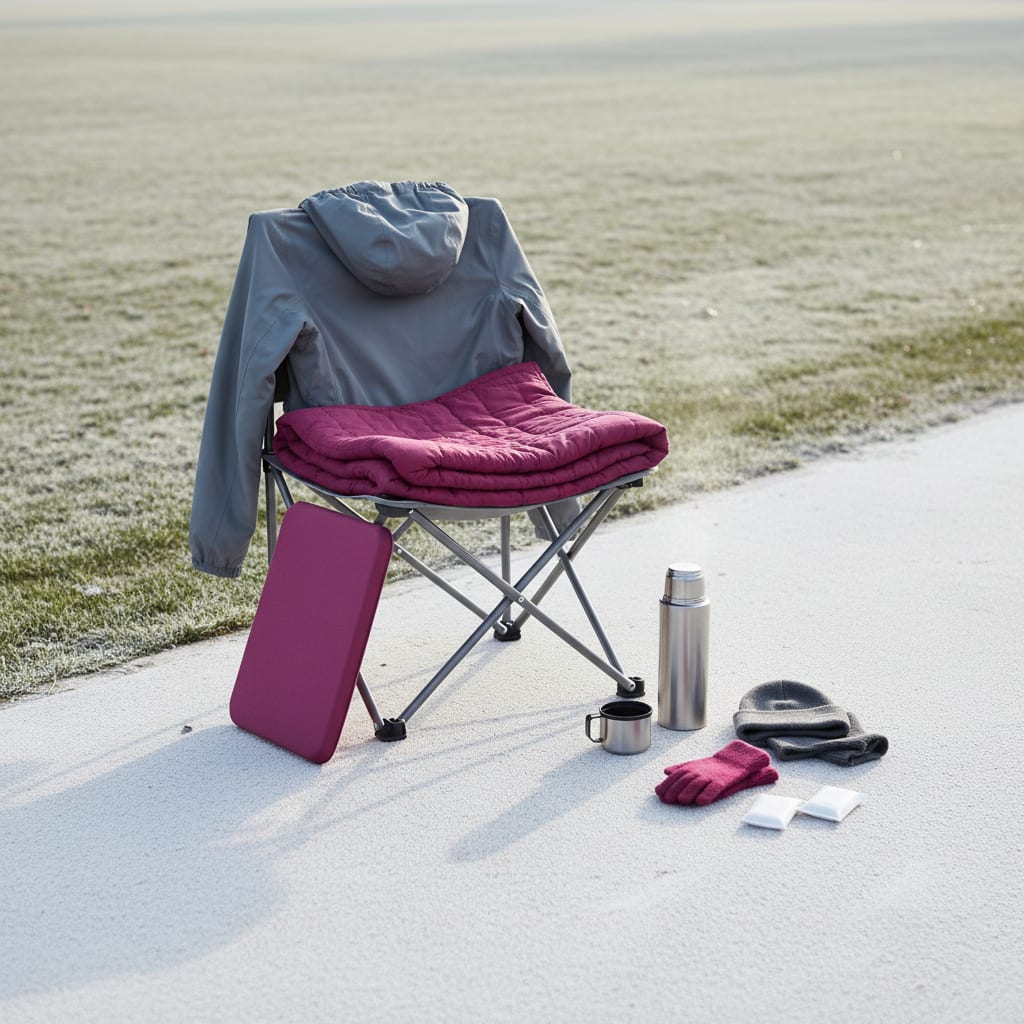
If you fix one thing this season, fix the seat. Cold metal or a thin sling of chair mesh drains heat continuously, and no amount of upper-body layering compensates.
What works, cheapest first: a closed-cell foam pad like the Therm-a-Rest Z Seat between you and the bleacher; a folded blanket under you rather than over you; a padded or high-backed chair instead of bare mesh. The parent sideline kit covers chair choice generally; the cold-weather amendment is padding under the sit bones, however you get there.
Then add the blanket you wrap up in — and in damp season a synthetic-fill outdoor one earns its keep over the fleece throw from the living room, because it keeps insulating when it gets misted on and it shakes dry. The Rumpl Original Puffy is the one that lives in most veteran sideline wagons: quilted synthetic fill, water-resistant ripstop shell, and it stuffs down small enough to fit in the wagon rather than eat it.
Hands, feet, and the heat you carry
Extremities go first and they take your mood with them.
- Hands. Gloves you can still open a bottle in, plus disposable warmers for the mornings that mean it. A bulk box of HotHands warmers lives in the bin from October; crack a pair at the car and they’re warm by the time you’ve set up. Follow the packet’s own instructions — they’re a pocket item.
- Feet. Wool socks and boots with an actual sole, not canvas trainers. Standing still on cold ground is the most efficient way there is to lose a morning.
- Head and neck. A hat covers what a hood doesn’t, and a neck gaiter is the highest warmth-per-ounce object in the bin.
- A hot drink. For morale, which is the resource that actually runs out at minute 55. A vacuum flask like the Stanley Classic Legendary bottle holds enough for you, the parent who forgot theirs, and the kid coming off at halftime — and the lid is the cup, so there’s nothing extra to lose in the grass.
Under the kit: what changes for the player
The player’s problem is the opposite of yours — they’re warm the second they start running and freezing the moment they’re subbed off.
- A thin long-sleeved base layer under the uniform, in a colour your league allows — check the rule before you buy, since some want it to match the shirt.
- Track pants and a jacket that go ON at every substitution. This is the whole game. A kid who cools down on the bench in a damp shirt plays badly after halftime and complains for two hours in the car.
- Gloves. Field players wear them now, universally, and nobody thinks anything of it.
- A dry shirt for the ride home — a permanent resident of the soccer bag from October onward.
- A hat for warmups and the bench, off at kickoff.
Anything about a kid’s health in the cold — how cold is too cold for them, whether it’s a day to play — is a question for your pediatrician and your league’s weather policy, not for me. Leagues publish their own cancellation lines; read yours before the first frost so you’re not litigating it in a group chat at 6am.
Cleats in the cold: the sock-thickness trap
Here’s the one that sneaks up. A thicker sock inside a boot that already fit in September makes it too tight, and a tight boot in cold weather is colder, not warmer — you’ve squeezed out the air layer. If your kid is going up a sock weight, re-check the fit in those socks; the thumb’s-width rule from the cleat sizing guide still applies, just measured in what they’ll actually wear.
On frozen ground, firm-ground moulded studs stay the sensible default for youth play. Frozen fields are hard, not muddy; longer studs solve a problem that isn’t happening.
What to skip
- Cotton as a base layer. It holds sweat against the skin and stays wet all morning. The one true rule of cold-weather clothing.
- A hood instead of a hat. Hoods blow off and leave your ears out. Wear both — the hood is for wind, the hat is for heat.
- A bigger coat when the problem is the chair. Diagnose the seat first. Cheaper, and it works.
- Ponchos and giant umbrellas. They flap, they catch wind, and on a crowded touchline they block everyone’s view but yours.
- A second everything, loose in the trunk. That’s staging rather than gear, and That Suburban Momma has built those bin systems properly. Mine is one lidded tote, packed the first cold Saturday, restocked at the new year.
Dry sideline observation: the warm parent is invariably the one who looks least prepared, sitting on a scruffy foam pad in a shell that has seen four seasons. The one in the beautiful new coat, standing on frozen ground in canvas shoes, leaves at halftime every time.
FAQ: staying warm at cold-weather games
How do you stay warm at a soccer game?
Insulate yourself from the seat first, then layer base-mid-shell with a genuinely windproof outer, then cover hands, head and feet. Bring a hot drink. Layering alone fails if you’re sitting on cold metal, which is why the seat comes first.
What should I wear to a cold soccer game?
A thin synthetic or wool base layer, a fleece or light puffy mid layer, and a wind- and water-resistant hooded shell. Wool socks, insulated boots, a hat and a neck gaiter. Skip cotton entirely.
How do kids stay warm during a game?
A thin long-sleeved base layer under the uniform if your league allows it. Off the field, a jacket and track pants that go on at every substitution, plus gloves and a hat for the bench. Subbing off is where kids actually get cold.
Should my kid wear different cleats in cold weather?
Usually not — firm-ground moulded studs handle cold, hard fields fine for youth play. Re-check the fit instead, because a thicker sock can make an autumn boot too tight.
What’s the one thing most sideline parents forget?
A windproof shell. Most people own plenty of insulation and nothing that stops wind, and wind is what turns a manageable morning into a wretched one. It packs small enough to live in the bin all season.