Your Kid's First Game: A Parent's Sideline Primer
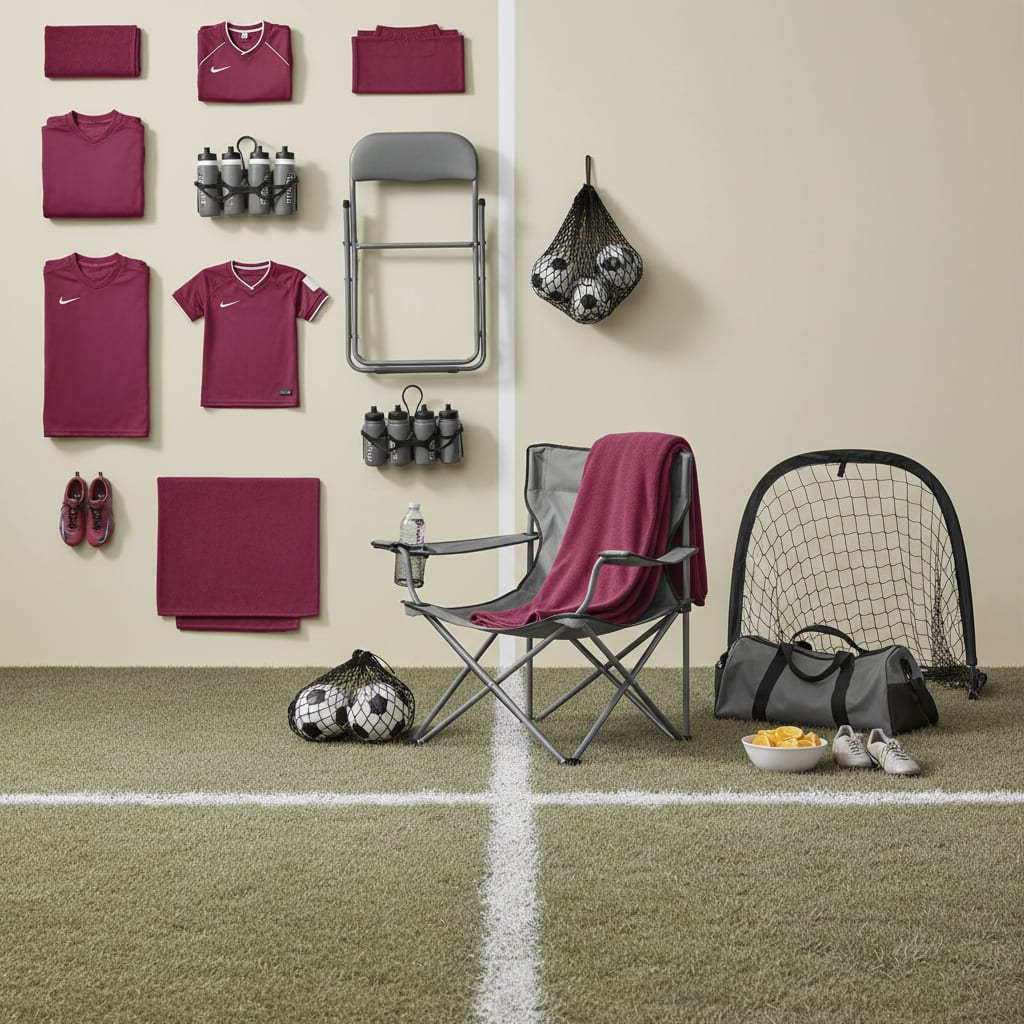
Your kid’s first game will be forty minutes long, mostly disorganized, and over before you’ve settled into your chair. Expect a swarm of players chasing one ball, at least one kid facing the wrong way, short quarters with frequent substitutions, and a final score nobody officially keeps. Arrive 30 minutes early, stand on the parents’ touchline, cheer for every kid on the field, and say “I love watching you play” afterward regardless of what happened. That’s the entire job. Here’s the longer version, in the order the morning happens.
The morning, in reverse
Work backwards from kickoff and the whole thing gets calm:
- Kickoff minus 30: arrive at the field. Not the parking lot — the field. Youth complexes are a maze of numbered pitches and the walk is longer than it looks.
- Kickoff minus 45: leave the house. Cleats on the kid’s feet, bag in hand, bottle full.
- Kickoff minus 60: breakfast, and the uniform goes on. Jerseys are always inside out at this stage. Always.
- The night before: bag packed and by the door, uniform located and confirmed to exist, and shin guards physically in your hand at some point. The single most common first-game emergency in youth soccer is shin guards that are in the house somewhere.
Your league’s welcome email will give you an arrival time. Take it at face value the first week — coaches use pregame minutes for warmups and a quick lineup talk, and a kid who walks up at kickoff starts the season one step behind socially, which matters more than tactically.
What a first game actually looks like
If your only reference is televised soccer, recalibrate now. At the youngest ages you’ll typically see small-sided play — 4v4 or 5v5 on a short field, often with no goalkeeper — in quarters rather than halves, with a swarm of players moving as a single organism around the ball. This is not bad coaching. It is the correct developmental stage, and it lasts a year or two.
Things that will happen, all of which are fine:
- Someone scores on their own goal, celebrates, and is celebrated.
- A player sits down in the middle of play. Grass is interesting.
- The ball goes out of bounds nine times in two minutes.
- Your kid touches the ball twice, total, and calls it the best day ever.
- A parent nearby says “spread out!” to children who do not know what that means.
Substitutions come thick and fast, playing time at rec level is usually shared by rule, and the coach is managing a roster of small people whose primary goal is to be near the ball. Judge the morning on whether your kid wants to come back next Saturday. That’s the only metric that predicts anything.
Where to stand — and where not to
Every field has an unspoken geography, and the first-game parent gets it wrong innocently.
Stand on the parents’ touchline, the side opposite the teams, several steps back from the line. Both benches — your team’s and the other one’s — get the other side. Never behind either goal: it puts you in the keeper’s eyeline and it is the one location that reliably annoys everyone.
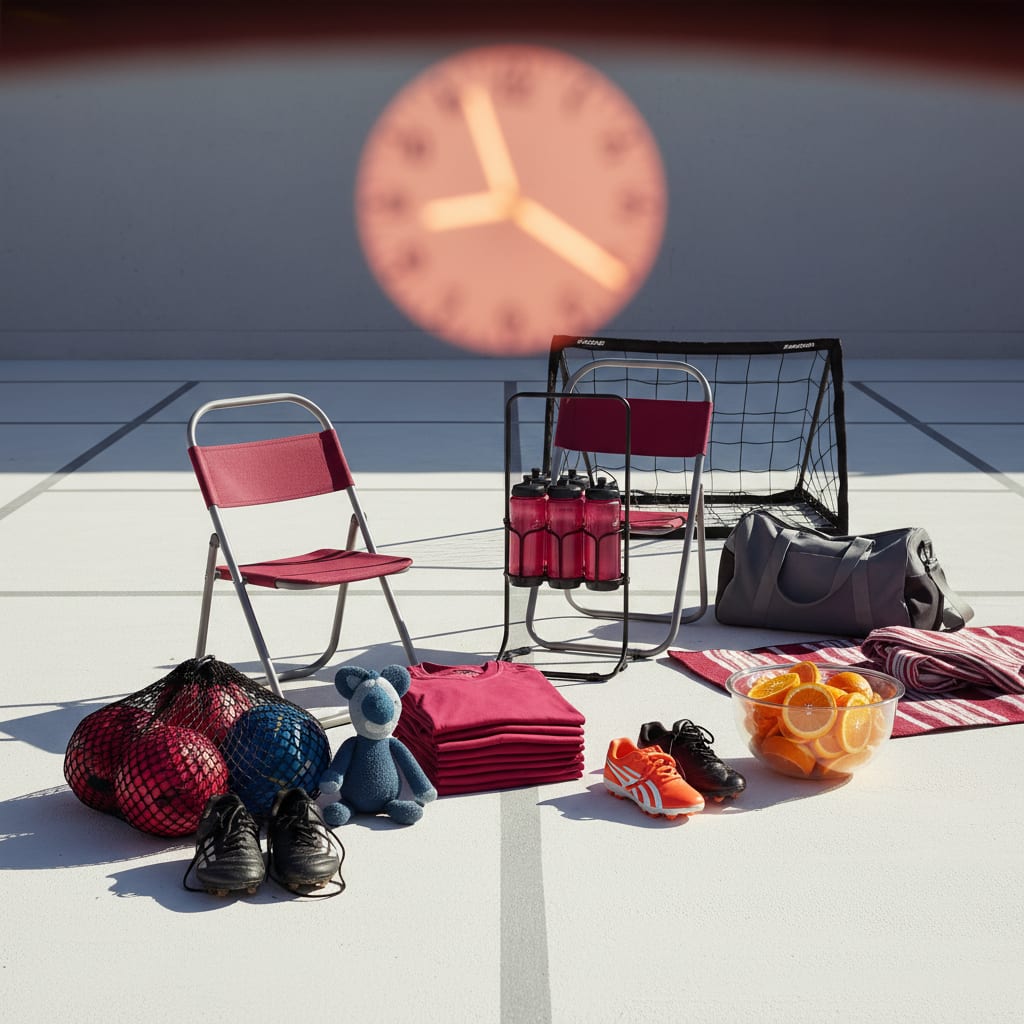
Leave a clear corridor for the assistant referee, who runs the touchline and needs the space. And keep the family setup — chairs, wagon, blanket, sibling — back off the line rather than crowded onto it. What belongs in that setup is its own conversation; the veteran sideline kit covers the chair-and-shade end of the operation, and the short version for game one is: a chair, water, and something for the sibling.
Dry sideline observation: you can identify every first-game family by proximity to the touchline. By week three, everyone has drifted back a meter, mostly because a ball has hit them.
What to yell (a very short list)
Encouragement, names, and applause for both teams. That’s the list.
Not on the list: instructions. Not “pass it,” not “shoot,” not “get back on defense.” Two adults giving different orders to a six-year-old is how a kid learns to look at the sideline instead of the field, and coaching-from-the-fence is the fastest way to make a fun morning feel like an evaluation. The full doctrine — including the part about referees, who are frequently teenagers doing a hard job for gas money — lives in the sideline etiquette rules. Read it before game one rather than after the incident.
One legitimate exception: safety-adjacent shouting is the coach’s and the referee’s job, not yours. If something needs stopping, they’ll stop it.
Halftime, the sub, and the meltdown
Three moments catch new parents off guard.
Halftime belongs to the coach. Resist the urge to intercept your kid for a private strategy session — let them huddle, drink, and go back out. If they come to you, hand them water and say something light.
Coming off for a sub is not a punishment, even when your kid’s face says otherwise. Rec teams rotate on a clock. Cheer the kid coming off exactly as loudly as the one going on.
The meltdown — tears over a goal conceded, a missed shot, a collision with a teammate — is normal and usually over in ninety seconds. The move is calm proximity, not a speech. First games are emotionally enormous and small bodies process that through crying, mid-morning.
The car ride home
This is the part that decides how the next twelve Saturdays feel. The scoreboard is done; you are now the entire postgame show.
Say “I love watching you play.” Then hand them a snack and let them talk, or not talk. No performance review, no highlight breakdown, no “you should have” — and if they went scoreless, that’s not a topic. The full script for wins, losses, and benchings is in what to say after the game, and it’s four words plus silence, which is much harder than it sounds.
If the whole season still feels like an unmapped country — registration, practices, the volunteer asks, the mid-season slump — the first-season parent’s guide maps out the months on either side of this Saturday.
FAQ: your child’s first soccer game
What time should we arrive for a first youth soccer game?
About 30 minutes before kickoff, at the field itself rather than the parking lot. Coaches use that window for warmups and a lineup talk, and complexes are bigger than they look on the map.
How long is a youth soccer game?
At the youngest ages, typically around 40 minutes of play split into short quarters, with frequent substitutions. Games get longer as age groups climb. Your league’s rules sheet has the exact structure, and it’s worth a two-minute read before game one.
Does everyone play the same amount in rec soccer?
Most recreational leagues have equal-play or minimum-play rules, and coaches rotate on a clock. Travel and select programs generally do not guarantee minutes. If you’re unsure which set of rules governs your team, ask the coach at a non-game moment.
What should I bring to my kid’s first game?
A chair, water for everyone, sun or rain protection, and a snack. The kid’s bag carries their own cleats, guards, socks, bottle, and ball. Everything else is optional at game one.
Should I cheer for the other team’s kids too?
Yes, and it sets the tone for your entire sideline. Applauding a good play regardless of jersey is the clearest signal you can send a six-year-old about what the morning is for.
What if my kid doesn’t want to go out on the field?
Common, and usually temporary. Let the coach handle the invitation, stay relaxed and visible, and don’t negotiate from the touchline. Plenty of first-game sideline-sitters are fully in by week three; pressure at minute one is what turns a shy Saturday into a lasting refusal.