Your Kid's First Soccer Season: What Nobody Tells Parents
A first youth soccer season is eight to ten weeks of one practice and one weekend game, played small-sided on a short field, and it will look almost nothing like soccer on television. This post starts the day you have already registered — if you are still deciding when to start soccer, that question has its own post and this one will not answer it. Expect swarming, expect a kid who scores on the wrong goal at least once as a family, expect the coach to be somebody’s dad who watched three YouTube videos and is doing his honest best. Your job is smaller than you think: get them there fitted and fed, cheer without instructing, and let week six be better than week one on its own schedule.
Week one: nobody knows anything, including the coach
You have clicked pay, so: the first practice is administrative chaos. Half the roster is missing, two kids are in sneakers, one is attached to a parent’s leg, and the coach is trying to learn eleven names while a dog runs through the drill. This is normal. It is normal every single year, in every sport, in every town.
What to do: show up ten minutes early, walk your kid to the coach, say their name out loud, and leave. Then go sit down. The walk-away is the whole skill of week one, and it is a parent skill, not a kid skill.
What a practice actually contains
An hour-long rec practice for 5- to 8-year-olds is roughly: fifteen minutes of arrival and warm-up chaos, twenty minutes of one or two drills, and twenty-five minutes of scrimmage, which is the part they came for and the part they’ll talk about in the car. If the coach runs anything more elaborate than that, they will regret it around minute forty.
The number worth watching isn’t the drill quality, it’s touches. A good rec practice has your kid’s foot on a ball a lot; a weak one has eleven kids in a line waiting for a turn. If it’s all lines by week three, that’s a polite conversation with the coach at the end of a session — not a crisis, and not a group-chat post.
What game day actually looks like
Small-sided games at this age run short halves or quarters, often with no keeper, on a field a fraction of full size. Substitutions happen in clumps. Scores may or may not be officially kept, and will be kept unofficially by every child on the field regardless of league policy — this is a law of nature and you should not fight it.
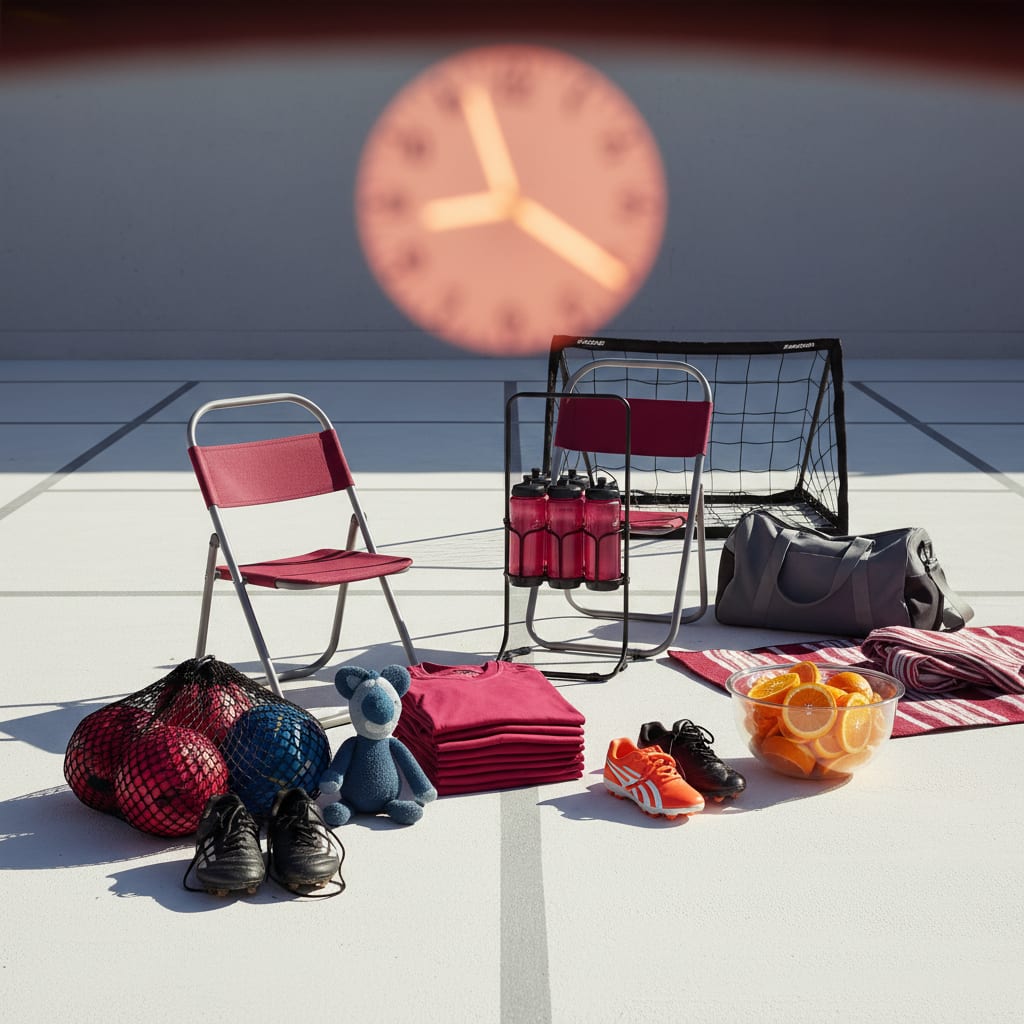
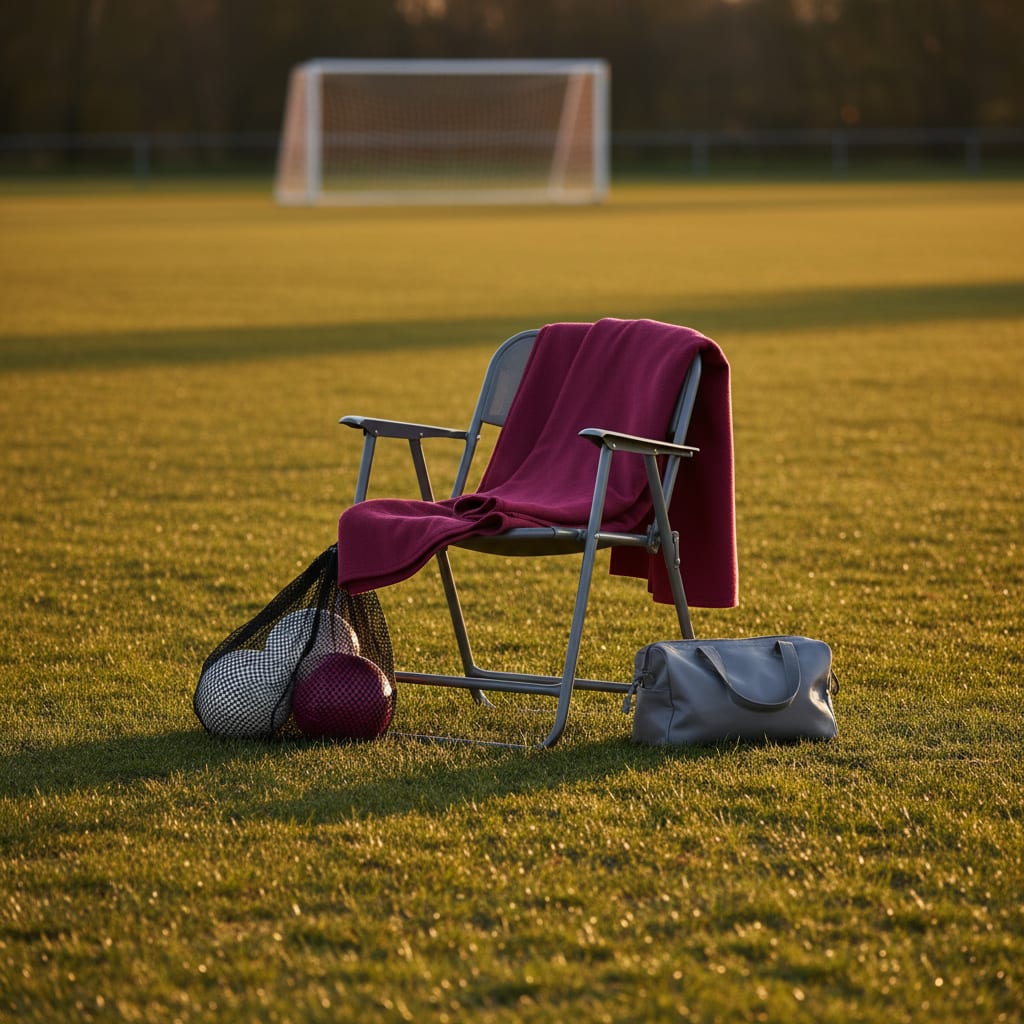
Arrive twenty minutes early. That buffer is the difference between a kid who warms up and a kid who spends the first quarter finding his feet. Bring the sideline kit — chair, water, shade, blanket — because the one thing new sports parents universally underestimate is how long a person can stand in a field with nothing to sit on.
The buy list, and the list you can ignore
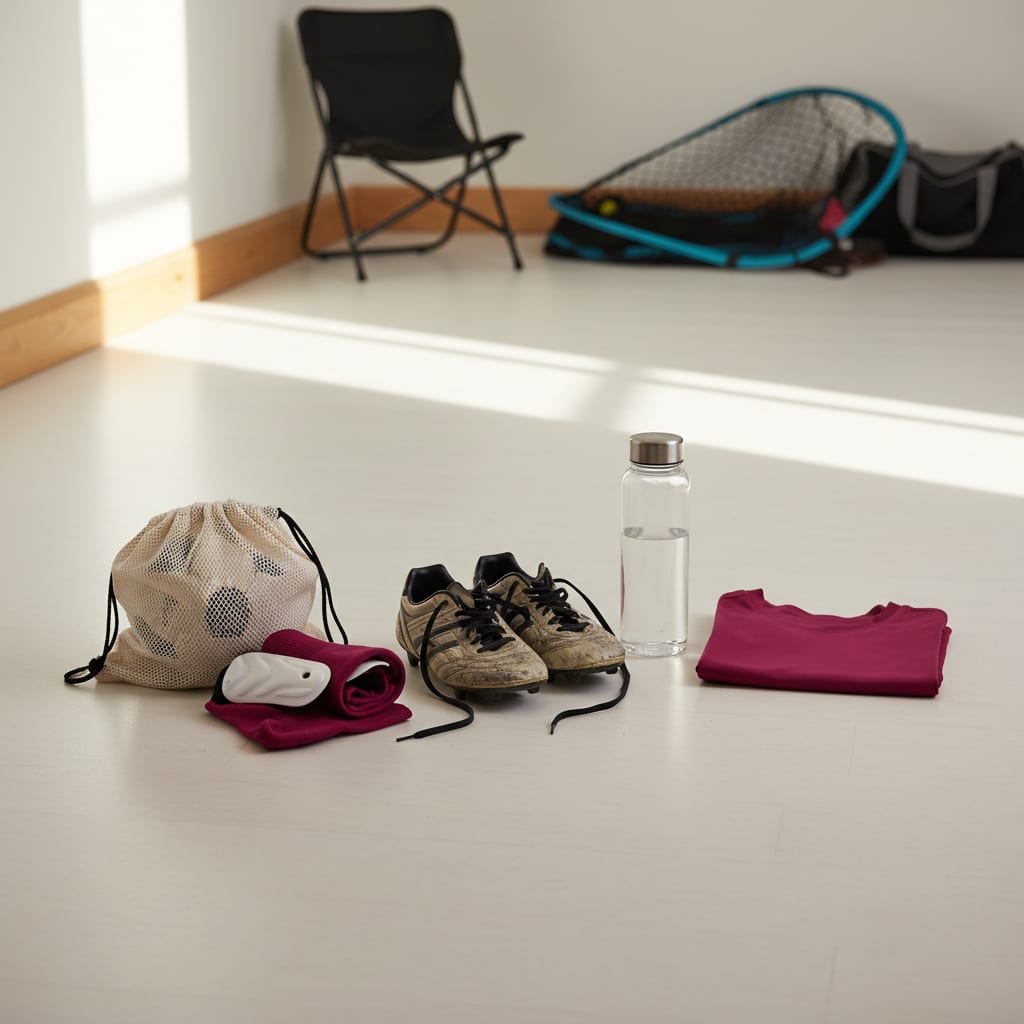
You need four things for a first season: cleats that fit, shin guards, a ball in the right size, and a real water bottle. That’s it. The full what-to-buy-what-to-skip breakdown is a separate scouting report, but two things belong here because they’re the ones that go wrong in week two:
Cleats. Buy the size that fits today. The classic first-season error is a full size up to “get two seasons,” which produces sliding, blisters, and a season of touches that arrive a half-beat late — the full fitting checklist takes four minutes on the kitchen floor and saves the season.
Shin guards. They go under the sock, and the sock is the long soccer sock, and this will be explained to you sharply by a referee if you get it wrong. Size so the guard covers most of the shin without hitting the ankle bone; an ankle-guard pair like the Vizari Malaga is an easy first buy.
What you can ignore for now: goalkeeper gloves, a second ball, a bag with the kid’s name on it, anything with the word “elite” on the tag, and any pre-season skills clinic being marketed at your six-year-old.
The arc of the season, in four beats
Nobody hands you this timeline, so here it is.
Weeks 1–2: the fog. Your kid may follow the pack, may pick daisies, may cry. All three are within spec. Do not draw conclusions.
Weeks 3–4: the click. Something small works — a real kick, a stolen ball, a coach saying their name approvingly — and their posture changes. This is the week most kids decide whether they like soccer, and it happens for reasons you cannot engineer.
Weeks 5–7: the grind. The novelty’s gone, the weather turns, and at least one Saturday you will all be in the car in the dark asking why you did this. This is also when the actual improvement shows up. Push through this stretch; it’s the whole game.
Weeks 8–10: the wrap. They’re visibly better than in September, there’s a small trophy or a certificate or a popsicle, and you find out whether there’s a second season in this kid. The end-of-season party is a whole ceremony of its own, and it is somebody else’s department in every sense.
The three mistakes new sports parents make
Coaching from the fence. The single most common one and the most corrosive. Your kid can hear you, cannot process two coaches at once, and will look at you instead of the ball. Cheer effort, cheer everyone, use names, and let the coach coach — the unwritten sideline rules exist because a lot of us learned this the hard way.
Debriefing in the car. The postgame analysis feels like involvement and lands like a performance review. Snack first, silence second, conversation if they open it.
Treating week two as evidence. A bad practice is a data point about a Tuesday, not about your child. Commit to the season you paid for, then decide.
What surprised me most
The thing I didn’t expect, four seasons in, is how much of a first season is logistics dressed as parenting. The kid plays the season. You run a small transportation and laundry company with a snack subsidiary, and the families who enjoy the fall are the ones who built the machinery in week one — the gear staging by the door so nothing gets hunted at 8:40 on a Saturday, and a snack answer that isn’t a gas station.
The other surprise: the kids who love it aren’t the good ones. They’re the ones whose parents were calm.
FAQ: your child’s first soccer season
How long is a youth soccer season?
Most rec seasons run about eight to ten weeks, with one weeknight practice and one weekend game. Community-center programs are often shorter — six weeks, one night, no separate game day — which makes them an excellent trial run.
Should I stay and watch practice?
Stay for the first one or two, at a distance, then start using the hour. Kids concentrate better without a parent in eyeline, and the leave-and-return teaches something worth more than the drill they’d have run.
What if my kid doesn’t want to go one week?
Go anyway, once. Most week-five reluctance is tiredness wearing a costume. If it repeats and gets bigger, that’s a different conversation, and it deserves a real framework rather than a bribe at the door.
Do I need to buy a soccer ball if the team provides them?
Yes — for home, not for practice. The ball in your garage is what makes the difference between a kid who plays soccer twice a week and a kid who plays soccer. Get the size their age bracket uses so it feels the same.
What do I say after a rough first game?
“I love watching you play.” Then hand them food. That’s the entire script, and it holds up for about a decade.