Flag Football for Kids: What Age to Start, What to Expect
Most youth flag football leagues start at age 5, with the biggest and best-run divisions between 6 and 10. Seasons are short — commonly six to ten weeks in the fall, sometimes a spring session — and a typical week is one practice plus one weekend game. Play is 5v5 or 7v7 on a small field, no blocking, and a “tackle” means pulling a fabric flag off a belt. If you’re registering now for a fall season you’re on schedule; sign-ups in most towns run July into August.
Age for flag football: what age leagues actually start
Age 4–5. Introductory divisions exist and are essentially organized running with a football involved. Kids grab at flags, forget which way they’re going, and hand the ball to whoever’s closest. Charming, not really football.
Age 6–8. The genuine entry point, and where flag is at its best. Kids hold a route in their head for about four seconds, which is how long the play lasts. Rosters are small, everybody touches the ball, and a first-timer is not lost.
Age 9–12. Real structure appears: play sheets, routes, a quarterback with opinions. It’s also where parallel tackle programs open, and where the conversation below happens.
Starting late. Flag is one of the friendliest sports to start at 10 or 11 — the skills are running and catching, and a late starter looks like a beginner for three weeks.
Flag’s underrated advantage over other first sports: plays stop and reset constantly, so an easily-overwhelmed kid gets a breather every twenty seconds. If yours ran out of gas at soccer’s non-stop pace, try flag before concluding they dislike teams.
Pee wee football vs flag football: not the same thing
If you searched age for pee wee football: pee wee names a division, not a sport, and in its original home it is a tackle division.
Pop Warner’s national age-divisions page lists six divisions set by age and weight, two carrying the name — Jr. Pee Wee at 8-9-10 and Pee Wee at 9-10-11, each with an older-but-lighter provision admitting one older age under tighter weight limits. It also states a child’s age on July 31 is their age for the season. (Loaded 2026-09-19.)
Its flag program uses none of those names: one regional Pop Warner site lists flag divisions as Cub 5-7, Bobcat 8-10, Wildcat 11-13, Panther 14-16.
In your town it may mean nothing so precise — plenty of rec departments use it loosely for the little-kids program. So the registrar question is not what age is pee wee. It is which sport does that division play, and what age band this year?
How a flag football season actually runs
The rhythm is the friendliest in youth sports, and it’s why busy families migrate here.
- Length. Six to ten weeks, versus the ten-to-twelve-week haul of fall soccer.
- Practices. Usually one hour a week; some 5–6 divisions skip standalone practice — thirty minutes before the game and go.
- Games. Short halves on a running clock, often several games on one field in an afternoon.
- Field. A third to half the length of a full field, sometimes across the width of one.
Because games cluster, you make fewer separate trips than in almost any other sport — often the whole week is one two-hour block. Map it before you click pay rather than in week three; the practice-night time map at That Suburban Momma is the tool for it.
The rules that surprise parents
Flag isn’t tackle with the contact removed; it’s a different game with its own rulebook, and most leagues use a version of these:
- No blocking. Offensive players can’t shield defenders, so the sport rewards speed and route-running over size.
- No fumbles. A dropped ball is dead where it lands, removing most of the pile-ups a parent imagines.
- Rush lines. Defenders start a set distance off the line, often seven yards, and a designated rusher counts before crossing. Hence the quarterback has time.
- No diving or flag guarding. Ball carriers can’t swat a defender’s hand away or leave their feet — the rule that stops the game becoming contact by accident.
- Everybody plays. Most rec leagues mandate minimum plays or rotate positions — the best predictor of whether a six-year-old enjoys October.
The gear list (it is very short)
The cheapest entry of any organized sport my kids have played:
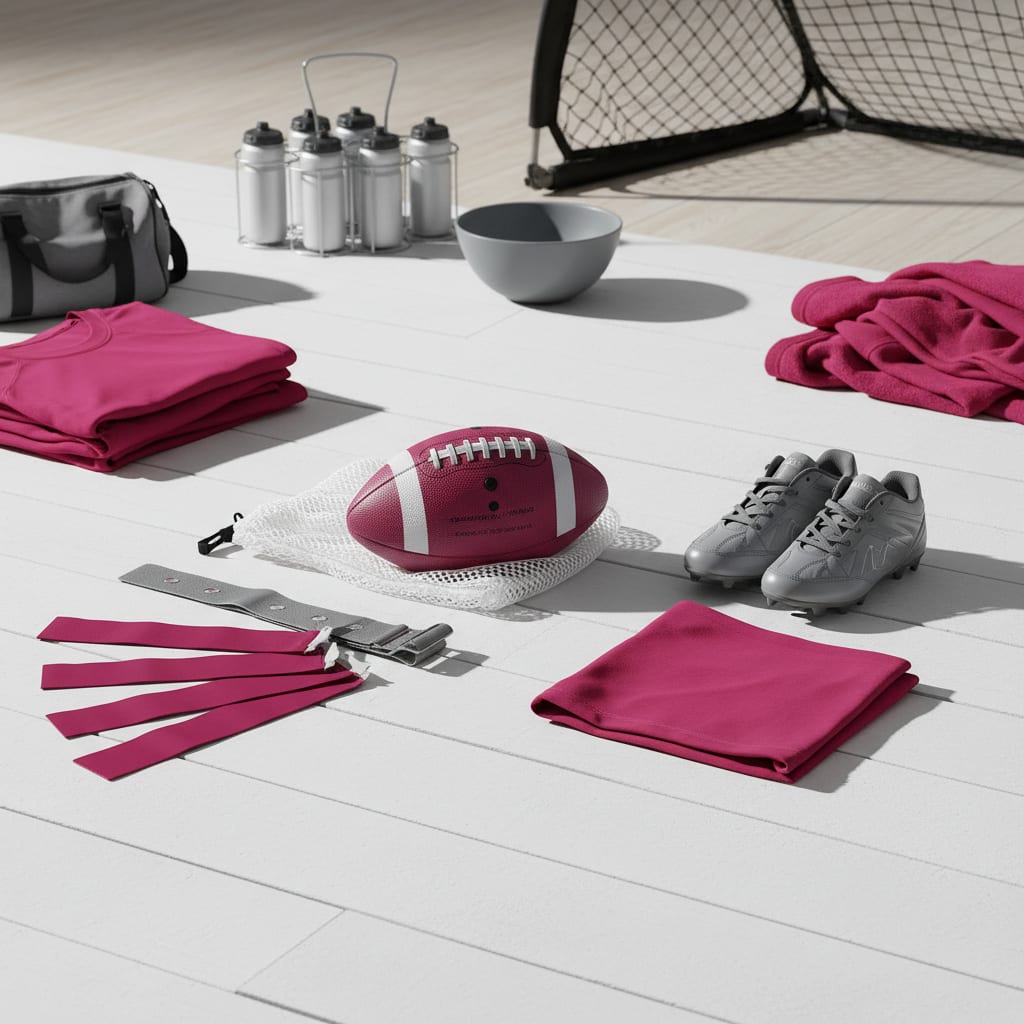
- Cleats. Football or soccer cleats both work. Fit them the way you’d fit any first-season cleat: thumb’s width at the toe, heel locked, no sizing up to grow.
- Shorts with no pockets. Pockets catch flags and most leagues ban them outright.
- The league jersey and flag belt. Almost always included in registration — don’t buy a belt for it.
- A mouthguard, if the rulebook requires one. Check the rulebook, not the internet.
- A youth-size football for home. Junior and pee-wee BALL sizes are smaller — same word, different meaning from the divisions above.
That’s the whole list, and it’s why flag is often the cheapest box on the which-sport-first menu. For the backyard, one purchase makes practice work: a 12-player adjustable flag football set, enough belts for a driveway game. The flags are the consumable, so buy the set with spares.
Flag or tackle? What the family conversation is actually about
This generates more heat than any other question in youth football, so let me be precise about what this post can and can’t tell you.
What I won’t do here: give you medical or safety guidance. That’s outside this site’s lane on purpose. If your decision rests on injury risk — and for many families it reasonably does — the sources worth your time are your pediatrician, the CDC’s HEADS UP program, and the American Academy of Pediatrics. Read them directly rather than a blog’s summary, including mine. And the one rule every parent carries onto any sideline: if a head injury is suspected, the child comes out of play and sees a doctor. Nobody at the field clears a kid — not the coach, not you.
What I can tell you is the logistics picture, which is what most families actually weigh:
| Flag | Tackle | |
|---|---|---|
| Typical start age | 5 | 8–10; varies by state and league |
| Season length | 6–10 weeks | Often 10–14 weeks plus preseason |
| Weekly time | ~1 practice + 1 game block | Frequently 2–3 practices + a game |
| Gear cost to family | Low; mostly cleats | Higher; leagues vary on what they supply |
| Roster size | 5v5 or 7v7, everybody touches the ball | Large rosters, uneven playing time |
| Summer commitment | Minimal | Conditioning weeks common before the season |
The honest read: for many families the deciding factor isn’t philosophy, it’s that tackle asks three or four evenings a week from August onward and flag asks one. If your household is at capacity, that’s a legitimate reason and you don’t owe anyone a bigger one. Worth knowing too: flag football is on the Olympic program for 2028, so it’s a destination sport now rather than a waiting room.
Three questions to ask before you pay
Ask the registrar: is there a minimum-play rule? (it separates a rec league from a competitive one in rec clothing), do you rotate positions? (every kid should get a turn at quarterback at 6U), and how long is a game day, really? — “Saturday” can mean forty minutes or five hours with a gap in it.
FAQ: youth flag football
What age can kids start flag football?
Most leagues open at 5, with introductory 4-year-old divisions in some towns. The 6-to-8 range is where it’s genuinely fun and comprehensible for a first-timer.
Is flag football good for a first team sport?
One of the best. Short seasons, a four-item gear list, simple rules, and a low skill floor — running and catching are things most kids already do.
What do kids wear to flag football?
Cleats, shorts without pockets, the league jersey, the belt the league supplies, and a mouthguard if the rulebook requires it. Pockets are the thing parents forget, and the referee notices.
How long is a youth flag football season?
Commonly six to ten weeks in the fall, often with a spring session too. One practice and one game block a week — lighter than most sports at the same age.
Do kids need to play flag before tackle?
Not as a rule, though many coaches favor it because flag teaches route-running, catching and field awareness without the extra layer. Whether and when to move to tackle is a family decision involving your pediatrician, not a blog.