Why Kids Talk to Themselves for an Hour Before Sleep
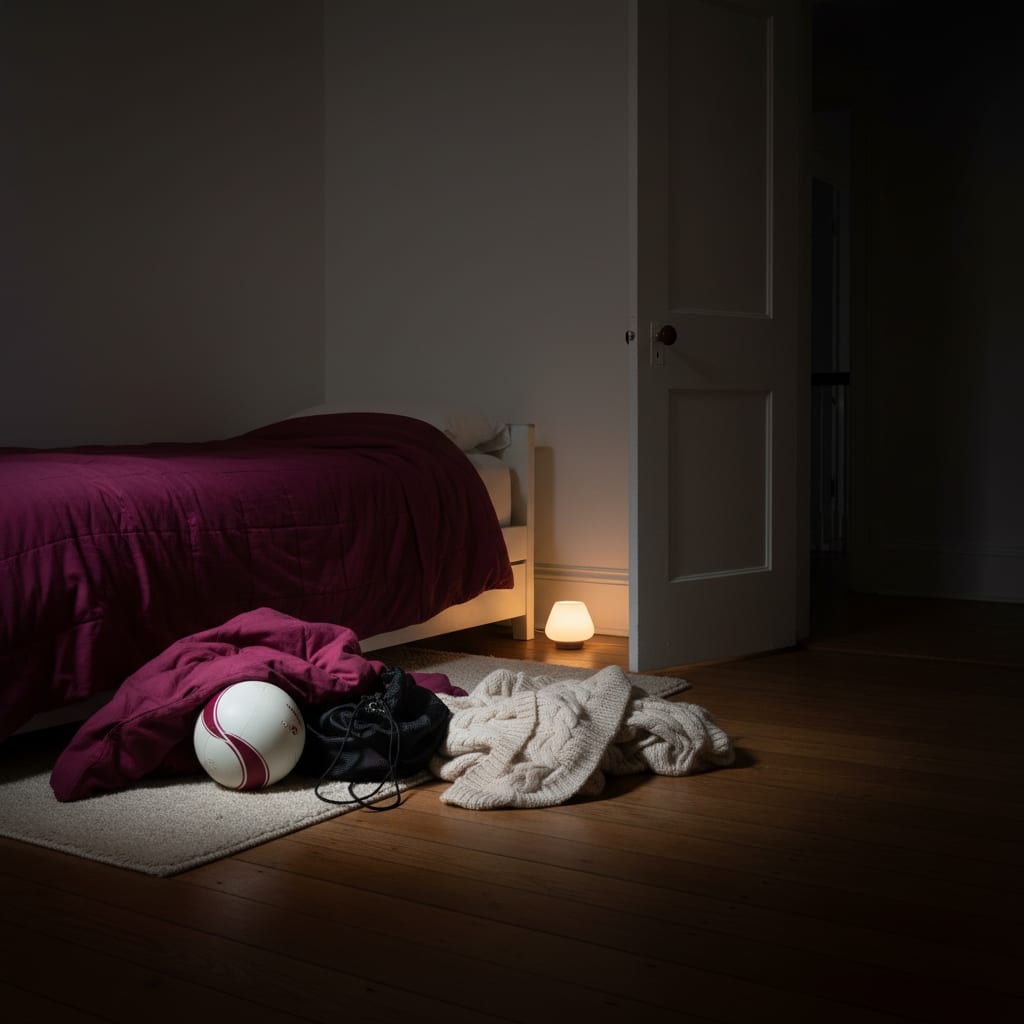
A child who lies in the dark narrating for an hour before falling asleep is doing something ordinary, and usually the opposite of what it looks like. Bedtime is the first unoccupied moment they have had all day — no ball, no screen, no adult asking a question — and the day comes back out loud. In a sports household it comes back later and louder, because the day did not end at five. Nothing here needs fixing; what often needs moving is where the replay happens.
What the hour actually sounds like
Stand outside the door and it is rarely one thing.
There is play-by-play — the whole practice again, narrated in third person like a broadcast. There is instruction on repeat: whatever the coach said last, said back to the ceiling four or five times, sometimes in the coach’s voice. There is rehearsal, where a kid runs a conversation they intend to have tomorrow and tries three versions of it. And there is straight invention — a game that does not exist, a scoreline nobody will check.
It is loud, it is confident, and it stops the instant the door opens — which tells you it was never for you.
Why a late practice makes it longer
The mechanism is not complicated: the more that happened in a day, the longer the replay, and a 6:30-to-8:00 practice slot loads the last waking hour with the most vivid material of the whole day.
Three things stack up. The event is recent — a kid in bed at 8:40 has had ninety minutes to process ninety minutes of high-intensity everything. The event was social, and the social layer takes longer to sort out than the sporting one: who passed, who got picked, what the eleven-year-old said in the parking lot. And they are wired rather than sleepy, two states that both arrive at bedtime looking like refusal.
The dry version: the kid who could not tell you one thing about their school day at 3:15 will deliver a full oral history of a scrimmage at 8:55pm. That is not defiance. That is the only quiet they have had.
Fall is louder still for a few weeks, an ordinary feature of the first weeks of a new season — new team, new names, new coach, more to file every night.
Move the debrief out of the bedroom
This is the one change that does anything, and it costs nothing.
If the day is going to get replayed, give it an earlier slot with an audience. The car ride home is built for it — dark, side by side, no eye contact, a captive adult. Ask one open question, then stop talking. Most of what would otherwise go to the ceiling at nine goes to the windshield at 8:15 instead.
Two rules make that work. Keep it their debrief, not yours — the moment it turns into feedback on their first touch, they stop offering material and save it for the dark, where nobody corrects them. And keep it short. Same approach as what to say after the game, on a Tuesday with no scoreboard involved.
The other half is what you ask at 8:45. A well-meant “what did coach say about your positioning?” at lights-out is a starting pistol. Ask it in the car.
What to leave alone
A surprising amount of this gets worse when handled.
- Going in to shush them. You have added a person to the room, which extends the whole thing and gives the talking an audience it did not have.
- Making a rule about it. “Ten minutes of talking then quiet” turns a self-limiting habit into a negotiation with a clock in it, enforced at 9:15.
- Adding a wind-down step. Lengthening bedtime because a kid is struggling is how a twenty-minute routine becomes fifty minutes permanently.
- Treating the noise as awake. A reported hour of chatter is often nineteen minutes of chatter and forty minutes of a parent on the monitor deciding what to do about it. Time it once from the hallway.
The real question underneath is whether bedtime lands early enough to absorb a long wind-down at all, which is a schedule problem rather than a talking one — the same math as protecting an early bedtime when practice ends at eight.
The little one doing the same thing next door
Sports households usually have a second, smaller version going, and it sounds different: sing-song, repetitive, a lot of naming things, sometimes a full conversation with a stuffed animal about the wagon.
Treat it the same way, and time it before you believe your own estimate. A kid dragged to a field four evenings a week has a day to process too, and no vocabulary to file it with. Betteroo’s rundown of how much sleep a three-year-old actually needs is a better reference point than the monologue’s length, because the total is what matters and the chatter mostly is not.
Where it turns into calling out, getting up, and a bedtime that has genuinely doubled, that is a different pattern — the two-to-five-year-old wobble covers it better than I can. The language and development side of the small years belongs to writers who cover that age properly — besttoddlertips is the one I read. My lane starts where the kid has a jersey; the sideline logistics of the smaller one are the sibling-in-tow plan.
When it’s worth mentioning to your pediatrician
Everything above assumes ordinary narration by a kid who is fine in the daytime. A few things are worth raising with your pediatrician rather than solving at the door:
- The talking is distressed rather than chatty — the same worry circling night after night, or a kid who sounds upset rather than busy.
- Daytime is going badly: exhausted, unusually irritable, or falling asleep in places kids do not fall asleep.
- It arrived suddenly and has not settled, or keeps growing rather than shrinking.
- Anything about it worries you that this post has not covered.
I coach eight-year-olds in a rec league. Your pediatrician knows your kid. Any question with a medical shape goes to them, and no bedtime strategy is a reason to delay asking.
Where a plan actually helps
Everything above is general. What is hard to look up is your household, this week: a three-year-old whose nap half-collapsed in August, a dinner that has migrated to 7:15. That is the gap a personalised plan fills — roughly $20 a month, built for the baby and toddler range, adjusting wake windows and bedtimes as the week actually goes rather than handing you a chart that assumed everyone was home at five.
It will not shorten a play-by-play or move a practice slot. It will tell you whether the bedtime underneath the talking lands where it should, which is the half you can change. A tool, not magic.

FAQ: talking to themselves at bedtime
Is it normal for a child to talk to themselves before falling asleep?
Yes — it is one of the most common things parents notice at bedtime and it is not a problem to solve. Kids replay the day, rehearse conversations and invent whole games out loud, then fall asleep mid-sentence. It usually fades on its own.
Does talking at bedtime mean my child isn’t tired?
Not usually. Wired and sleepy arrive at the same door on a practice night and look identical from outside the room. Time it once from the hallway before assuming it costs an hour — it is often shorter than it sounds, and often the last stage before sleep rather than a delay to it.
Should I go in and tell them to be quiet?
Generally no. Going in adds a person to the room and gives the monologue an audience, which extends it. Unless someone else’s sleep is being wrecked, leaving it alone is faster.
How do I make the bedtime monologue shorter after a late practice?
Give the day an earlier slot. A short debrief in the car home — one open question, then you stop talking — moves most of the replay out of the bedroom. Then ask nothing about practice once the lights are off.
My kid keeps repeating what the coach said. Is that a bad sign?
Mostly it is a good one: repeating an instruction back is how a kid rehearses it. If it sounds anxious rather than like practice — the same phrase over and over, with an edge to it — raise it with your pediatrician.