Tournament Weekends: Sleep When the Bracket Owns Saturday
A tournament weekend breaks sleep in three specific places, and knowing which one you’re in is most of the fix. The 7am call time shortens the night at the front. The shared hotel room makes the youngest kid’s bedtime everyone’s bedtime. And the baby’s nap, which has never once consulted a schedule, lands squarely in game two. You can’t make a bracket flexible. You can decide in advance which sleep you’re protecting and which you’re spending — and doing that on Thursday is the difference between a hard weekend and a wrecked one.
What a tournament weekend actually does
Three ordinary problems, stacked, arriving at once.
The front of the night gets cut. A 7am check-in means a 5:45 wake-up for the whole family, and nobody meaningfully “banks” sleep beforehand. An early Friday bedtime helps a little; mostly you’ll be short.
The room collapses everyone into one schedule. At home the eleven-year-old reads until nine and the baby is down at seven, in different rooms. In one hotel room those facts are in direct conflict.
The little one’s day loses its shape. No familiar room, no usual cot, a schedule set by other people’s game times.
Each has a different answer. Treating it as one problem called “we won’t sleep” gets you nowhere.
Working backwards from the call time
Take the earliest call time and build Saturday backwards from it. Wake-up is call time minus about 75 minutes on site, minus travel if you’re not. Friday bedtime is wake-up minus whatever that child needs — a number you already know for the school-age player, a moving one for the toddler.
Two things make it survivable:
- Move Friday bedtime earlier by 30 minutes, not 90. Big shifts don’t take; a small one usually does, especially after a physical day.
- Stage the kit Thursday so Friday evening is calm. A frantic 8pm search for a shin guard costs you the early bedtime you just engineered. The packing-system side is That Suburban Momma’s territory; my point is only that chaos at 8pm is a sleep problem wearing a logistics costume.
Then accept the trade. Saturday will be short. Recovery happens Sunday night, not Saturday afternoon, and pretending otherwise leads to the classic error — a 4pm rescue nap that pushes bedtime to ten and turns one hard night into three.
One room, two bedtimes
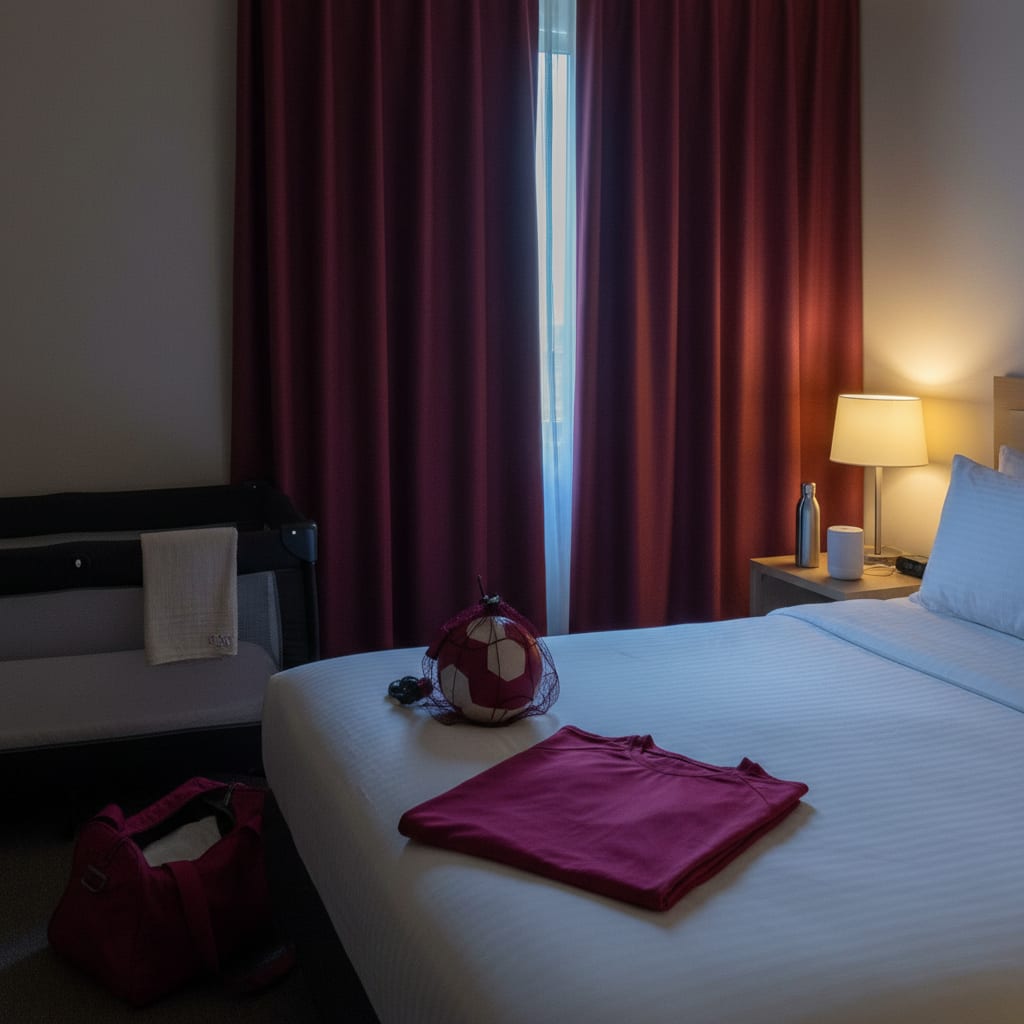
The hotel room is where most families come unstuck. The practical moves, in rough order of how much they buy you:
- Book a divider if you can — a suite, an alcove, connecting rooms if the budget stretches. A physical barrier beats any technique.
- Make a dark corner. The travel cot goes in the entry hall or the far side of the bed, away from the TV and the lamp. Hotel curtains rarely close fully; a couple of clips fix that.
- Bring the sound. A portable Yogasleep Rohm covers corridor doors, the ice machine, and a sibling turning over. In a shared room it does more work than anything else you packed.
- Give the big kid somewhere to be. A headlamp and a book at the far end, or twenty minutes downstairs with the other parent. Asking an older child to be silent from 7pm isn’t a plan, it’s a hope.
- Adults go quiet early too. Getting ready for bed at 10:30 is a wake-up event.
Whether room-sharing helps or hurts genuinely cuts both ways — Betteroo’s rundown of sharing a room versus separate rooms is level-headed on the tradeoffs. For one weekend, though, it’s a containment exercise rather than a decision about how you live.
Where a baby sleeps in a hotel room is a safe-sleep question rather than a logistics one, and it isn’t mine to answer — the AAP’s guidance lives at healthychildren.org, worth reading before you book. The travelling half — hotel choice, road-trip logistics, what a family needs in a room — belongs to The Travel Mommy.
The nap that ignores the bracket
On a tournament Saturday the baby’s nap is the only item on the schedule with no external authority behind it. Game two is at 1:40 because a bracket says so. The nap is at 1:40 because a person needs it. Only one of those can move, so it always does.
What actually helps:
- Pick which game you’ll half-watch. Decide Friday, not at 1:30 in a car park. Knowing in advance turns a failure into a plan.
- Let the car or stroller nap count. A moving nap is a real nap this weekend; purity is a luxury of ordinary weeks.
- Know what “enough” looks like at this age. A 35-minute car nap means something different at seven months than at two years, which is where a rough sense of how long naps run by age saves you from panicking or coasting.
- Split the parents formally. One on the field, one on the nap, swap for game three. Both doing half of each is how nobody watches anything and nobody sleeps.
- Defend the evening over the mid-day. If something must give, give up the nap and protect bedtime.
Our sideline bag plan for the kid in tow still applies, just doubled — a tournament day is three of those sessions back to back, with no house to retreat to.
Sunday, and the week after
Sunday is not the recovery day — it’s usually the harder one, because everyone starts short and there’s a drive home at the end. Recovery is Sunday night: normal room, normal routine, bedtime pulled 30 minutes early for everybody, and no attempt to also catch up on laundry.
Expect Monday and Tuesday to be ragged and read nothing into it. Two rough nights on the road don’t mean anything has regressed; run the ordinary routine and wait. Same principle as late practice nights and early bedtimes — structure is what recovers you, not a new strategy.
If you’re doing this for the fourth time this season and it genuinely isn’t working, that’s not a sleep problem — it’s a rec versus travel question, and a fair one to ask out loud.
Where a plan actually helps
Everything above is general. What’s hard to look up is your weekend: this baby, this age, a game three that ran late, dinner in a car park, an alarm set for 5:45. That’s the gap a personalised plan fills — around $20 a month, built for the baby and toddler range, adjusting wake windows and nap targets when the day moves instead of handing you a chart that assumed you were home at five.
It won’t make a hotel corridor quiet or a bracket reasonable. It will tell you what the day around a short night should look like, which is about the only variable you control. A tool, not a miracle.

FAQ: tournament weekends and sleep
How do I handle a 7am tournament call time with a baby?
Work backwards: wake-up is call time minus travel and about 75 minutes of getting ready, and Friday bedtime moves 30 minutes earlier — no more, because bigger shifts rarely take. Then decide which of Saturday’s games you’ll spend on a nap.
How do you get a baby to sleep in a hotel room with siblings?
Make a dark corner away from the lamp and the TV, run white noise loud enough to cover corridor noise, clip the curtains shut, and give the older child a headlamp and a book instead of asking for silence. Where a baby sleeps is a safe-sleep question — check the AAP’s guidance before you book.
Should I keep my toddler’s nap schedule on a tournament weekend?
Keep the shape, not the clock. A car or stroller nap on the way to game two counts, and one displaced day undoes nothing. Defend the evening instead — a late rescue nap that pushes bedtime to ten costs you the following day too.
How long does it take kids to recover from a travel tournament?
Usually a couple of ordinary days. Run the normal routine, pull Sunday bedtime slightly earlier, and resist changing anything else. A ragged Monday after two short nights is expected, not a sign something has broken.
Is it worth booking two hotel rooms for a tournament?
If the budget allows and there are two adults, it usually pays for itself — as does a suite or connecting rooms. A physical divider between a 7pm bedtime and a 9pm one solves more than any technique. Otherwise, dark corner plus white noise is the next best thing.