Your Kid's First Basketball Season: Rules, Practices, Games
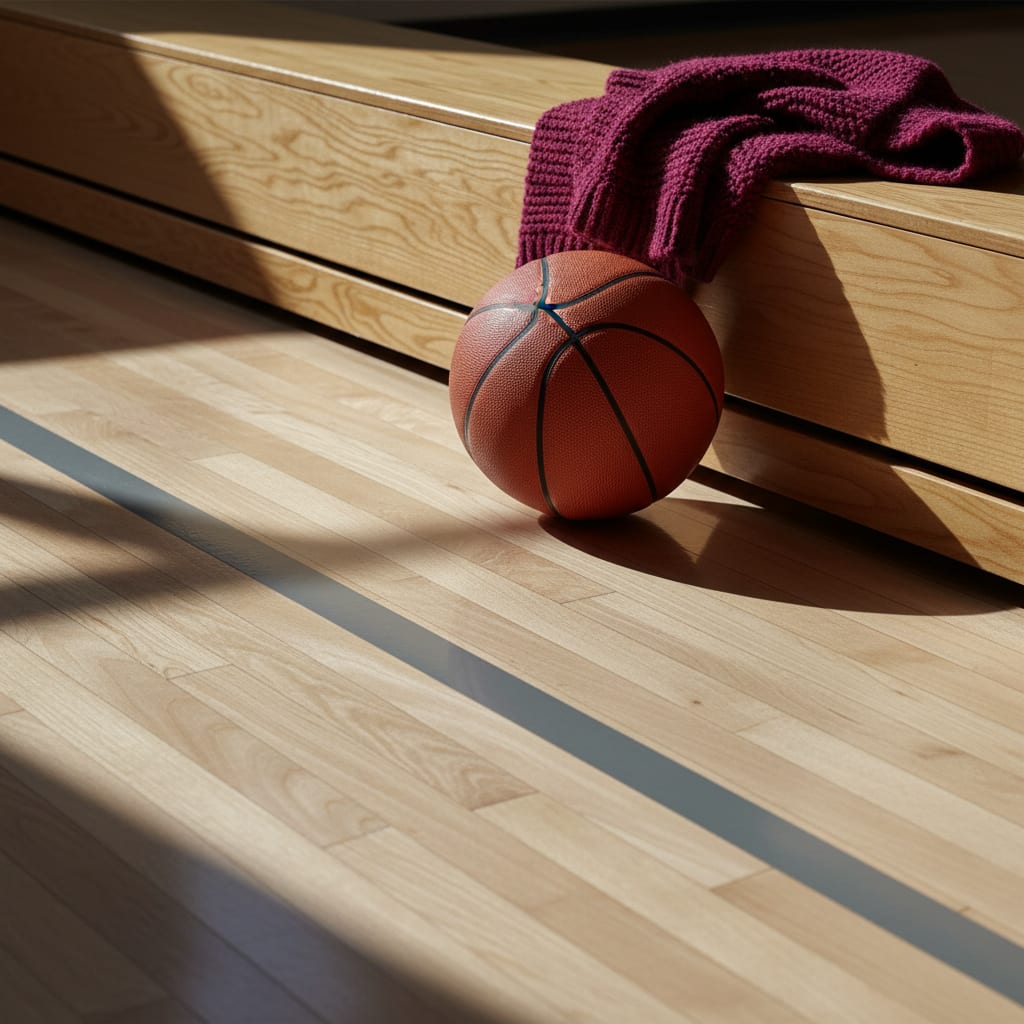
A first rec basketball season is usually one practice and one game a week, played on a lowered hoop with a smaller ball, under kids’ rules that change a little at almost every age. Under the NBA and USA Basketball youth guidelines, seven- and eight-year-olds play on an 8-foot basket with a 27.5” ball, equal playing time, player-to-player defense only and no stealing from the dribbler. Nine-to-elevens move to a 9-foot basket and a 28.5” ball, and still no three-pointers. Your league’s own rule sheet wins wherever it differs, so read it once before the first practice.
The kids’ rules, by age
Basketball’s youth rules are less a different sport than the same sport with the hard parts switched off until kids are ready for them. Here are the NBA and USA Basketball rules and standards charts, one PDF per age band, side by side:
| Ages 7-8 | Ages 9-11 | Ages 12-14 | |
|---|---|---|---|
| Basket | 8 feet | 9 feet | 10 feet |
| Ball | size 5 (27.5”) | size 6 (28.5”) | girls 28.5”, boys 29.5” |
| Free-throw line | 14 feet | 14 feet | 15 feet |
| Three-pointers | no | no | yes, from 19’9” |
| Game | four 8-minute periods | four 8-minute periods | four 8-minute periods |
| Playing time | equal | equal in periods 1-3 | coach’s discretion |
| Defense | player-to-player only, no double-teams | player-to-player only, no double-teams | presses and double-teams allowed |
| Stealing from the dribbler | not allowed | coach’s discretion | coach’s discretion |
| Shot clock | none | none | 30 seconds |
A few of those deserve a sentence each, because they’re the ones parents ask about from the bleachers.
No zone defense. Every kid guards one kid. At this age it’s how they learn to defend, and it also stops one tall eight-year-old from standing under the basket all game.
No stealing from the dribbler (7-8). The defender can’t just slap the ball away from a kid who’s learning to dribble. It looks strange the first time. It’s why the game moves at all.
Equal playing time. The guidelines require it for the whole game at 7-8 and for the first three periods at 9-11. If your kid’s minutes look equal, the coach is following the rules, not being soft.
No threes. The arc may well be painted on the floor, but at 7-11 a shot from out there counts as two. The point is to keep kids shooting from a range where their form holds up.
The guidelines also say “3-on-3 half-court play is also recommended for young players”, so don’t be surprised if your seven-year-old’s first “games” are three-a-side.
Your league’s sheet wins
The NBA and USA Basketball charts are recommendations, and they say plainly that facilities “may not always be able to accommodate” them: not every gym can lower a hoop. So local leagues write their own rules, usually by grade.
The Eau Claire YMCA’s 1st-6th grade rule sheet is a good example of what one looks like:
- 1st and 2nd grade: half-court games with two hoops, an 8-foot hoop, the 27.5” ball, and “Score will not be kept.”
- 3rd grade: a 9-foot hoop, girls on the 27.5” and boys on the 28.5”, still no score.
- 4th grade: full court, the 28.5” ball and the regulation 10-foot hoop.
- Everyone: “Man-to-man defense. No zone,” “No pressing,” and equal playing time is expected.
Notice that league puts fourth graders on a 10-foot rim, two years before the national guidelines would. Neither is wrong. It’s why the welcome email is worth five minutes, and why our youth basketball size chart carries a grade column as well as an age one.
What a practice actually contains
For ages 7-8, the guidelines recommend one practice a week of 30 to 60 minutes; at 9-11, two practices of 45 to 75 minutes. In a rec league, expect the shorter end and a coach who is also a parent.
A typical first-season practice: a warm-up with a ball for every kid, dribbling lines, layups from both sides (one of which will look like a shot put for the first month), a passing drill, and a scrimmage at the end that everyone waits for. If the gym is shared, practice may be a half court.
The most useful thing you can do between practices is ten minutes in the driveway. The basketball drills for kids post lays out six that work at home.
What game day looks like
Arrive when the coach says, which is always a little before tip-off. Kids warm up with layup lines; parents find the bleachers on their team’s side.
Then the game, which for first-season kids is mostly a crowd moving up and down the floor together. The ball gets carried. Somebody shoots at the wrong basket. The referee will call some travels and wisely let plenty of them go. In a league like Eau Claire’s younger grades, nobody is keeping score, and every kid on the court knows the score anyway.
Your job in the stands: cheer effort, cheer both teams’ good plays, and do not coach from the bleachers. The coach has one voice, and your kid can’t follow two. The car ride home has its own short rulebook: say you loved watching them play, and leave the rest.
Former point guard confession: the hardest part of my first season as a parent was keeping my mouth shut about box-outs. Box-outs can wait.
What to buy, and what to ask first
The short list is shoes, a ball for the driveway in the league’s size (an outdoor one like the Wilson NBA Authentic Series Outdoor, 27.5” for a seven- or eight-year-old), and a water bottle. The youth basketball gear list has the full version, including what the league almost always supplies. If the rulebook requires anything protective, such as a mouthguard, the rulebook will say so; follow it rather than any blog.
Practice nights, carpools and the family calendar are a whole other job, and That Suburban Momma’s practice-night time map handles that side.
Positions, briefly
In a first season, positions are loose. The point guard brings the ball up, the forwards and center play nearer the basket, and in a rec game at seven everyone mostly plays everywhere. Good coaches move kids around so each one dribbles, passes and defends. If your kid is “always a center” because they’re tall, that will change as everyone grows.
FAQ: your kid’s first basketball season
What age can kids start basketball?
Plenty of rec programs start around first grade, and the NBA and USA Basketball guidelines group players by single-year age from six. Driveway play can start whenever a kid can hold a small ball.
What are the rules of basketball for kids?
The same game with a lower hoop, a smaller ball, no zone defense, equal playing time and no three-pointers until about 12, under the national youth guidelines. Your league’s rule sheet sets the details.
How long is a youth basketball game?
The guidelines use four 8-minute periods at every age from 7 to 14. Leagues vary: the Eau Claire YMCA plays four 10-minute quarters with a running clock.
Do they keep score in youth basketball?
Some leagues don’t for the youngest grades. The Eau Claire YMCA keeps no score through third grade.
Should my kid play rec or AAU basketball first?
Rec, for a first season. AAU is a club and travel tier, and what AAU basketball is explains the difference when the time comes.