Youth Basketball Sizes by Age: 27.5 vs 28.5 vs 29.5
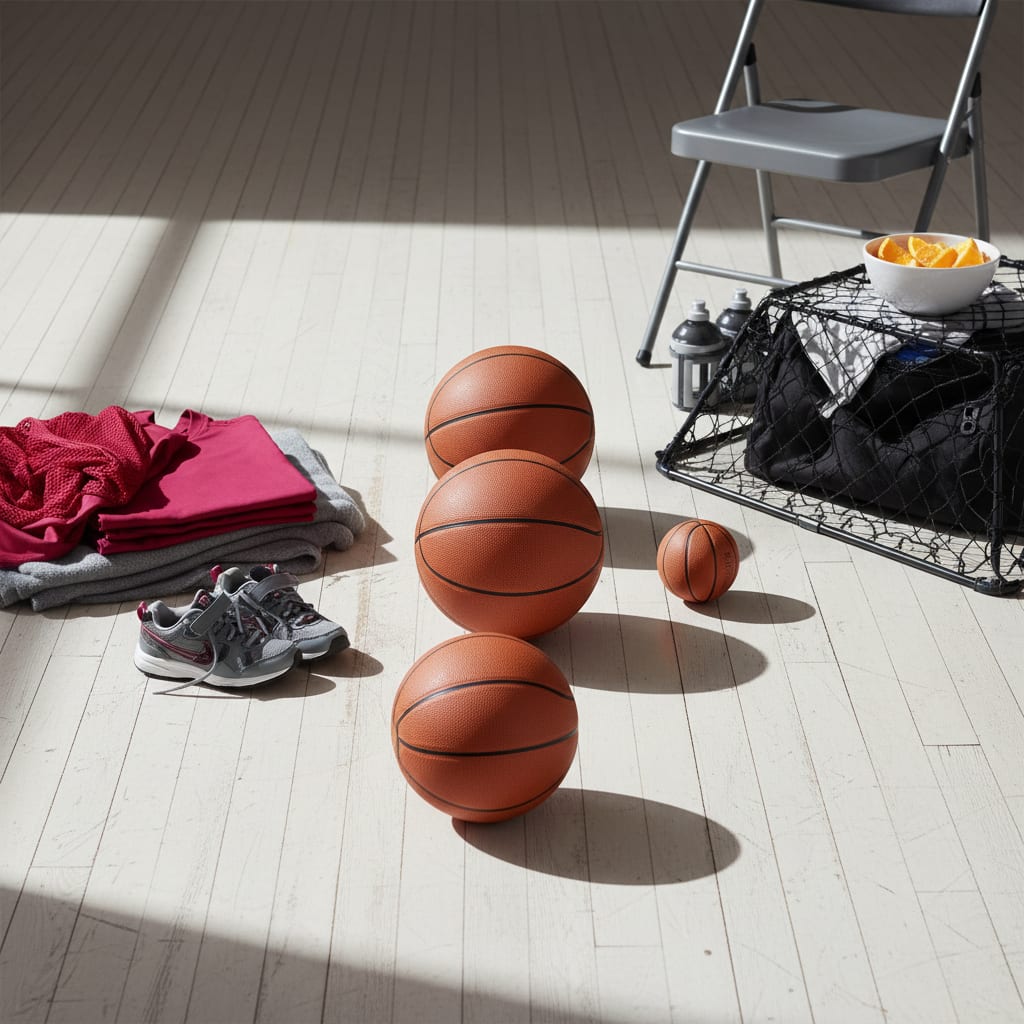
Youth basketball sizes go by circumference, and the NBA and USA Basketball’s joint youth guidelines settle the main ones: a size 5 (27.5”) for ages 7-8, a size 6 (28.5”) for boys and girls 9-11, then at 12-14 girls stay on the 28.5 while boys move to the size 7 (29.5”). Younger kids and driveway play use a 22” mini. Your league’s own rule sheet beats every chart, including this one, and plenty of rec leagues size by grade rather than age. The single most common mistake is buying the 29.5 because it’s the “real” one.
The chart, by age, U-age and grade
| Size | Circumference | Guideline age | U-age | One rec league’s grades* |
|---|---|---|---|---|
| 3 (mini) | about 22” | under 7, driveway | — | — |
| 5 (youth) | 27.5” | 7-8 | 8U | 1st-2nd; 3rd-grade girls |
| 6 (intermediate) | 28.5” | 9-11 all; 12-14 girls | 9U-11U; 12U-14U girls | 3rd-grade boys; 4th-6th |
| 7 (official) | 29.5” | 12-14 boys | 12U-14U boys | — |
*The grades column is the Eau Claire YMCA’s 1st-6th grade rule sheet, shown as one real example of how a rec league writes it.
The age column comes from the NBA and USA Basketball rules and standards charts, one PDF per age band. Their U-ages run on a “Playing Year” of September 1 to August 31, and each label is the oldest a player can be during it: a 12U player is 12 or under on August 31. Eighth grade is a transition year, and from ninth grade players group by grade. Nike’s basketball size chart lands close: size 5 for “age 9 and under”, size 6 for “girls/women age 9+ and boys 9-12”, size 7 for “boys/men age 12+”.
Two things a chart cannot do: override your league, or predict your kid. The Eau Claire Y is the worked example of why. Its third grade splits by team, girls on the 27.5 and boys on the 28.5, with a 9-foot hoop, and every team moves to the 28.5 and a 10-foot hoop in fourth grade. Other leagues draw that line a year either side. Check the welcome email first and buy to it, because a kid practicing with one size and playing games with another is doing two sports.
The other footnote: 28.5 is not a “girls’ training ball” on the way to something bigger. Nike’s chart lists size 6 for girls and women, so a 12-year-old girl on a 28.5 is on her permanent ball. That’s worth saying out loud in a house where an older brother lugs a 29.5 around like a status symbol.
Why size 7 in small hands is the expensive mistake
Cleats you size up and the kid grows into. A basketball doesn’t work that way. A ball that’s too big for the hand rewrites the shot: the kid shoots from the chest because they can’t get it overhead one-handed, the guide hand takes over and pushes, and the release turns into a two-handed heave. That form sticks. I’ve watched more than one fifth-grader spend a season unlearning a shot that a hand-me-down 29.5 taught them in a summer.
The guidelines make the same argument in plainer words: a smaller ball is advised “due to the size of a child’s hand as well as their developing skill level”, because it “allows for better control and success.”
Dry sideline observation: the driveways with the biggest ball almost always belong to the families with the youngest player.
The fit test that takes ten seconds
Hand the ball to your kid and watch, in this order:
- Can they hold it with one hand on top and walk three steps? Not palm it, just control it. If it slides off immediately, it’s a size too big.
- Can they shoot it above their head with one hand guiding? If the shot starts at the chest and both arms shove, the ball is winning.
- Can they dribble it at speed without slapping? Too-big balls get slapped rather than pushed.
If two of the three fail, drop a size. If your kid is genuinely on the border, go smaller for skill work at home and let the league ball be the bigger one. Good touch built on a slightly small ball transfers up. Bad form built on a too-big ball doesn’t transfer down.
Indoor, outdoor, and the material question
Size settles what to buy; the surface settles what it’s made of.
- Rubber is for driveways, blacktop and outdoor courts. Tough, cheap, bounces true on concrete. This is the family ball.
- Composite leather crosses over indoor and outdoor with better grip, but blacktop shreds it faster than the price suggests.
- Genuine leather is indoor only and entirely wasted on a nine-year-old whose ball lives in the yard.
For the driveway ball that gets rained on, left out and run over at least once, an outdoor ball like the Wilson NBA Authentic Series Outdoor in the 27.5” size is the worked example. The same line comes in a 28.5” size 6, so moving up is one click, not a research project.
Inflation matters more than most parents think: an underinflated ball bounces dead and a kid compensates by slapping harder. The pressure range is printed near the valve. Check it at the start of the season and again when the weather turns cold.
Buying for a growth spurt without buying wrong
The honest sequencing for a family that doesn’t want to buy a ball a year:
- Under 7: a mini. Low stakes, gets destroyed, replace it without emotion.
- About 7-8: one 27.5. The guidelines pair it with an 8-foot basket, and the driveway setup guide covers getting the hoop down to match.
- About 9-11: a 28.5, once the league moves. The guidelines pair it with a 9-foot basket.
- 12 and up: buy the league ball. Girls stay on 28.5. Boys are usually on 29.5 somewhere between 12 and high school, on the league’s schedule.
Three balls span elementary through middle school for most kids. Same buy-once logic as the soccer cleat sizing rules and the youth glove chart: sizing correctly is cheaper than sizing generously.
FAQ: youth basketball sizes
What size basketball should a 10 year old use?
The NBA and USA Basketball guideline for ages 9-11 is a 28.5” size 6, for boys and girls. Some rec leagues keep younger grades on the 27.5 a little longer, so check the rule sheet before buying.
What size basketball do girls use?
The same sizes as boys through age 11, then the 28.5” size 6 from 12 on. Nike lists size 6 for girls and women, so she doesn’t move up again.
What size basketball for middle school?
Under the guidelines’ 12-14 band, girls use the 28.5” and boys the 29.5”. School and club leagues set their own rules, so a 6th or 7th grader’s league may still differ.
What size is an 11U or 12U basketball?
11U is the 9-11 band, so 28.5” for everyone. 12U starts the 12-14 band: 28.5” for girls, 29.5” for boys.
What size ball does a 4th or 5th grader use?
Usually the 28.5”. The Eau Claire YMCA uses it from fourth grade, and some leagues start it in third. A younger or smaller fourth grader can still do driveway skill work on a 27.5.
When do boys switch to a 29.5 basketball?
The guidelines put boys on 29.5” at 12-14. Make the switch once, on your league’s schedule, not early because a bigger ball feels like a promotion.
What’s the difference between an indoor and an outdoor basketball?
Cover material. Outdoor balls are rubber and survive concrete. Indoor balls are leather or composite, softer in the hand, and wear out fast on blacktop. For one ball and a driveway, buy rubber.