Backyard Soccer Drills for Kids (No Whistle Required)
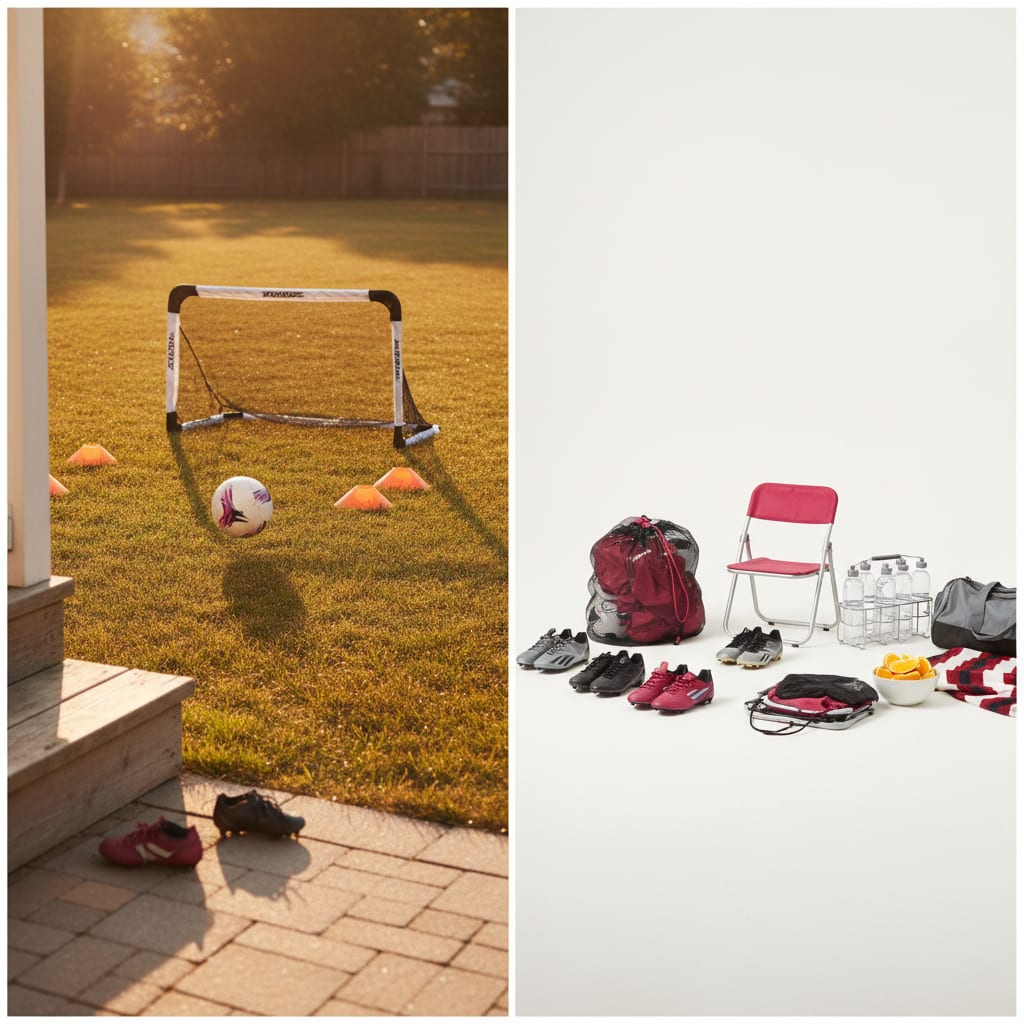
Backyard soccer drills for kids work when they’re games first and drills second: red-light-green-light dribbling, sock-ball first touches against the steps, cone slaloms with a timer, and finishing rounds on a pop-up goal. Ten minutes, a ball, and maybe four cones — that’s the full equipment and time budget. The rule that makes all of it work: you’re the rebounder and the timekeeper, never the lecturer. Backyard touches build the comfort-on-the-ball that one practice a week can’t, and they only keep happening if the kid walks away wanting tomorrow’s round.
The ground rules (read these before the drills)
Keep it short. Ten minutes, ideally the same ten minutes each day — the habit mechanics get their own post, but short-and-daily beats long-and-Saturday by a mile.
Right-size the ball. A size 3 for the under-8 crowd, size 4 for 8–12 — the ball chart lives in the gear list. The garage’s random size 5 teaches toe-poking and frustration in equal measure.
Score everything, judge nothing. Kids are motivated by counts — beat yesterday’s 12 touches, not “keep your ankle locked.” You call out numbers and enthusiasm. Technique corrections are the coach’s job on Tuesdays; the backyard’s job is volume and joy, and it stops working the minute it smells like a second practice.
Drill 1: Red light, green light (dribbling disguised completely)
The classic, with a ball. “Green” = dribble toward you, “red” = stop the ball dead with the sole. Younger kids just try to stop it at all; older kids must stop it within one touch or go back three steps. Add “yellow light” — slow motion, toe taps on top of the ball — once green is easy. Close-control training with a 100 percent kid-approval rating.
Reps: 10 greens and 10 reds, then stop.
Drill 2: Steps-and-sock first touch (the wall that lives at your house)
Every touch a kid gets in a game arrives from somewhere else, so the most valuable backyard skill is receiving. Use the bottom porch step, a garage door, or a wall: kid passes against it, controls the rebound, passes again. Count consecutive controlled touches; beat the record. No wall? You’re the wall — roll returns with your hands while drinking coffee. This drill is 80 percent of why “she’s so comfortable on the ball” gets said about certain kids, and it costs zero dollars.
Reps: 30 controlled touches, or three attempts at beating the standing record, whichever ends first.
Drill 3: The cone slalom time trial
Four cones (or shoes, or siblings’ abandoned toys — the equipment sponsor of most backyards) in a line, a body-length apart. Dribble through, turn at the end, come back; you run the stopwatch and announce times like a race commentator. The stopwatch is the whole psychology: kids grind against their own record forever, but wilt in a week if the time is compared to a sibling’s. Weak-foot runs get their own record — separate leaderboards, zero shame.
Reps: 4 timed runs; 2 weak-foot.
Drill 4: Finishing rounds (this is where the goal earns its keep)
Shooting into open grass is fine for two days, then it’s chasing practice. A target changes everything, and the right target is a pop-up goal, not a garage-space-eating frame: the standard is the PUGG 4-footer — folds to a flat disc, lives against the garage wall, sets up in five seconds. The game: five shots from five steps, count the makes, back up one step each perfect round. Add a moving ball later — you roll it across, they meet it, which is a genuinely advanced skill hiding inside a game a six-year-old will demand to keep playing.
Reps: 3 rounds of 5 shots, then out.
Skip the full-size backyard goal until you have a full-size backyard player; the pop-up does the same teaching for a tenth of the money and none of the wind-related insurance events.
Drill 5: One-v-one versus a parent who is terrible on purpose
The finisher: you defend the goal (or the space between two shoes), kid tries to dribble past. You are slow. You lunge theatrically and miss. Then, gradually, you commit less obviously — you can calibrate “barely worse than them” better than any drill card. When they beat you clean, react like it was a Champions League final. This one is disproportionately responsible for kids who want the ball in games instead of passing the responsibility away.
Reps: 6 attacks, then swap so they defend 6.
Drill 6: The turn box (the one nobody does, and it shows on Saturdays)
Mark a square roughly two body-lengths a side with whatever the backyard has provided. The kid dribbles in, turns inside the box, dribbles out the way they came. That is the whole drill, and it separates the kid who receives the ball facing their own goal and panics from the one who simply turns.
Name the turns so they can be requested: the sole roll (foot on top, drag it across), the chop (inside of the foot, ball goes back where it came from), and the stop-and-go (dead stop, one beat, gone). One turn per round, called before they start.
Reps: 10 turns, five on each foot. Two minutes, and it is the two minutes that shows up in a game.
The same six drills at 5, at 8, and at 11
Nothing here needs replacing as a kid grows. Same drill, different ask. Coaching a group of kindergartners? Use the soccer drills for 5-year-olds instead.
| Drill | At 5 | At 8 | At 11 |
|---|---|---|---|
| Red light, green light | Stop it at all | Stop it in one touch | Stop it and turn |
| Steps-and-sock touch | Two-touch, hand-rolled returns | One-touch against the wall | Weak foot only; thigh returns |
| Cone slalom | Four cones, no timer | Timer, own record | Weak-foot runs, tighter spacing |
| Finishing rounds | Static ball, three steps out | Back up a step per clean round | Rolling ball, first time |
| One-v-one | You are comically slow | You commit properly | You actually try |
| Turn box | Sole roll only | Sole roll and chop | All three, called mid-run |
The mistake runs the other way: an eleven-year-old handed the five-year-old version, and a quiet backyard.
Backyard soccer drills for a wet, dark November
Half the soccer year happens after sunset in a yard you would not cross in socks. The ten-minute habit survives it, but only if you stop running the summer version.
- Move to the driveway. Porch light and concrete beat a dark swamp. Slalom and turn box work on concrete; finishing does not, and that is fine.
- Swap the ball, not the drill. A rolled sock turns the steps-and-sock drill into an indoor one. Sole rolls and toe taps need no space at all.
- Cut the count, keep the slot. Five turns instead of ten, at the same time of day. The habit is the thing you are protecting, not the rep total.
- Let the wet weeks be short weeks. Two sessions in a January week is a win. Nobody lost a season in a February backyard.
The weekly shape (if you want structure without a clipboard)
You need variety, not a plan. A loose rotation: touch-wall Mondays, slalom Tuesdays, turn box Wednesdays, finishing Thursdays, one-v-one whenever there’s an extra adult and daylight. On nights the schedule’s already eaten, skip guilt-free — the habit survives missed days fine; it doesn’t survive becoming a chore.
FAQ: backyard soccer practice
How long should backyard soccer practice be for kids?
Ten minutes daily-ish beats an hour on Saturday, full stop. End while they still want more — “one more round” left unplayed today is tomorrow’s session pre-sold.
What equipment do I need for backyard soccer drills?
A right-sized ball and four of anything cone-shaped covers drills 1–3 and the turn box. A pop-up goal upgrades finishing from chasing practice into a game. That’s the complete shopping list; agility ladders and speed chutes can stay in the store.
My kid only wants to shoot, never dribble. Bad?
Completely standard — shooting has fireworks, dribbling has homework energy. Don’t ban the fun; tax it: every finishing round starts with a slalom run to arrive at the shot. Skill smuggled inside the thing they already love clears customs.
Should I correct my kid’s technique in the backyard?
Sparingly to never. One cue a week, delivered as a game tweak (“bet you can’t do it with your laces”), is the ceiling. The backyard’s advantage over practice is that nobody is evaluating anybody — spend it on volume and confidence, and let Tuesday’s coach own the ankles.