Soccer Drills for 5-Year-Olds That Don't Involve Lines
The best soccer drills for 5-year-olds are games where every child has a ball and nobody stands in a line. Five-year-olds usually play U6, and U.S. Soccer’s own guide for that age lists small-sided games of “1v1, 2v1, 2v2”, “Shooting games with lots of chances to score” and “No set playing positions.” So the six U6 soccer drills below are tag, treasure and target games, not passing lines. They fit into a 30-minute session that works in a backyard with one kid or on a field with ten.
If you’ve been handed the U6 team with a bag of balls and a whistle, this is for you too. You don’t need the whistle.
Why lines don’t work at five
A line of eight five-year-olds waiting for one turn is seven kids not touching a ball, and at least two of them have found a dandelion. U.S. Soccer’s U6 age-group guide is direct about the coaching side too: “Keep instructions short,” “Use regular short breaks to break up activities,” and “Find different ways to include all players in each activity.”
Turned into rules for a parent:
- One ball per kid. The single biggest change you can make.
- Explain in one sentence, then play. If it takes longer than that to explain, the game is too complicated.
- Short games, many breaks. Five or six minutes per game, then water.
- Everyone scores, often. Goals are the reward, so make them easy to get.
The ball itself should be a size 3 at this age in most leagues; the soccer ball size chart has the details and the exceptions.
Game 1: Sharks and minnows (with no one knocked out)
Every child is a minnow with a ball. One adult is the shark, without a ball. The minnows dribble from one side of the space to the other while the shark tries to kick their balls away. A minnow who loses the ball fetches it and keeps going. No elimination, because the kids who get knocked out first are the ones who need the touches most.
What it builds: dribbling with the head up, and keeping the ball close when someone is coming.
Game 2: Treasure raid
Put all the spare balls in a pile in the middle. Each child has a “home” (a cone, a hoop, a towel) at the edge. On “go”, they dribble out, take one ball, dribble it home, and go back for another, one at a time. When the middle is empty, they can raid each other’s homes.
What it builds: dribbling with a purpose, stopping the ball, and turning.
Game 3: Gates
Set up pairs of cones as “gates” about two steps wide, scattered around the space. Children dribble through as many gates as they can in one minute, counting out loud. Second round: try to beat that number. Third round: only the left foot, and watch the faces.
What it builds: dribbling in traffic, changing direction, and counting, which the parents will appreciate.
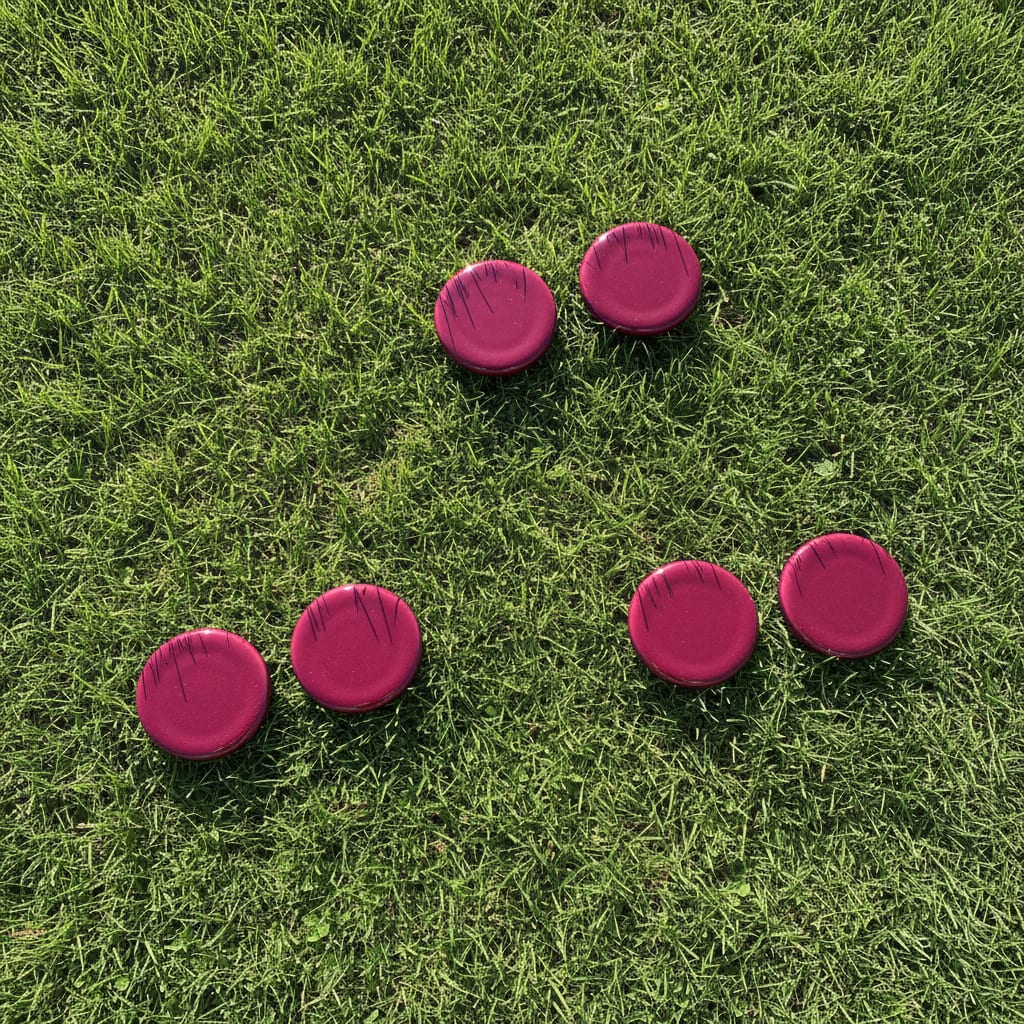
A set of low disc cones like the SKLZ 2-inch agility cones is the one piece of kit that runs four of these six games. Shoes work in a backyard.
Game 4: Body-part freeze
Everyone dribbles freely. You shout a body part (“knee!”, “bottom!”, “elbow!”) and everyone stops the ball with that part. The silly ones are the point. Five-year-olds will dribble an extra two minutes just to sit on a ball.
What it builds: close control, and stopping the ball on command, which is half of what a first season asks.
Game 5: Knock down the cones
Set tall cones or plastic bottles in a row along one side. Children dribble up and shoot to knock them down from a few steps away. Every knocked-down target goes back up. No goalkeeper.
What it builds: shooting with lots of chances to score, which is exactly what U.S. Soccer’s U6 guide asks for.
Game 6: Tiny-goal 2v2
End every session with a game. Two small goals, no keepers, two or three a side. With one kid at home, it’s you against them, and you are reliably, comically slow. A pair of small pop-up goals like the PUGG 4-foot goal set folds into a bag and fits in the car for practice.
What it builds: the actual game, at the size five-year-olds can see.
Sideline observation, free: you will see the whole group of five-year-olds chase one ball in this game no matter what. That’s not a coaching failure. It’s five.
A 30-minute session, in order
| Minutes | Activity | Notes |
|---|---|---|
| 0-4 | Free dribble around the space | Every child has a ball from the first minute |
| 4-9 | Body-part freeze | Warm-up and listening practice |
| 9-11 | Water break | Non-negotiable |
| 11-17 | Sharks and minnows or treasure raid | Pick one, swap next week |
| 17-19 | Water break | |
| 19-24 | Gates or knock down the cones | Count out loud |
| 24-30 | Tiny-goal 2v2 | End on a goal for everyone |
At home with one child, cut it to fifteen minutes and three games. That’s plenty. For a team, keep the order and change the games week to week so they don’t get stale.
How this differs from the backyard drills for older kids
Our backyard soccer drills use six drills that scale from five to eleven, and they work at five too. The difference here is the format: this page is built around a five-year-old’s attention span, so every activity is a game with one rule, and everything happens at once. Once your child can wait a turn without leaving the field, the drills there make a good next step.
If you’re coaching the U6 team
- Learn the names first. “Go, Maya!” beats “Go, number six!” at this age.
- Use parents as sharks. It keeps the sideline busy and the kids delighted.
- Skip positions. U.S. Soccer’s U6 guide says “No set playing positions,” and at five they wouldn’t hold them anyway.
- Celebrate effort out loud. A five-year-old who stopped the ball with their bottom did what you asked.
For everything around the field itself, from cleats to snack schedules to the first game, the first soccer season guide covers what nobody tells parents.
FAQ: soccer drills for 5-year-olds
What are good soccer drills for 5-year-olds?
Games where every child has a ball: sharks and minnows, treasure raid, gates, body-part freeze, knocking down targets, and a small 2v2 game. Keep each one to five or six minutes.
How long should soccer practice be for 5-year-olds?
About 30 minutes for a team session with water breaks, and around 15 minutes at home. U.S. Soccer’s U6 guidance recommends regular short breaks between activities.
What do U6 soccer players learn?
U.S. Soccer’s U6 guide lists dribbling, running with the ball, receiving and shooting, plus small-sided games of 1v1, 2v1 and 2v2. It also says no set playing positions at this age.
Should 5-year-olds play with a goalkeeper?
Not in practice games. Small goals with no keeper give every child more chances to score, which is the point of shooting games at this age. Check your league’s rules for game day.
How do I keep a group of 5-year-olds focused?
One-sentence instructions, a ball for every child, and games short enough to finish before attention runs out. Change the game before they get bored, not after.