How to Teach a Kid to Hit: Tee First, Then Toss
To teach a kid to hit a baseball, go in the order Little League’s own practice plans use: the grip, then the stance, then dry swings with no ball, then the tee, and only then a tossed ball. In the backyard that toss comes in two stages: soft toss from the side, then front toss from in front, with plastic balls. Keep each session to about ten minutes, and keep the cues to two: “knocking knuckles” for the grip and “eyes on the ball” for everything else. Move up a stage only when the current one is boring.
This is the third of the backyard baseball trio, after catching and throwing. Hitting comes last for a reason: it is the hardest of the three, and it is the one parents most want to rush.
Why the tee comes first, even for kids who hate it
A swing has a lot of moving parts, and a pitched ball adds the hardest one: timing. The tee takes timing out, so the kid can learn the swing itself. Little League’s coach-pitch plans keep the tee in practice long after tee ball. In week four, each player hits “five balls off of a tee into a net or fence” while waiting for their turn against live pitching.
Kids who think the tee is babyish usually change their mind when you give it a target. More on that below.
Step 1: the grip
Little League’s tee ball plan for week two gives the cue as a question. “Which is your favorite hand/your throwing hand? That hand goes on top, the other below.” It also says the bat “should be held in the fingers and pads of fingers,” not in the palms.
The coach-pitch plan for week three adds the cue that sticks: grip the bat with “knocking knuckles” lined up, or shifted slightly. If the middle knuckles of both hands line up roughly, like a fist about to knock on a door, the grip is close enough for a seven-year-old.
The same tee ball plan opens with the rules: players “must always keep two hands on the bat, never throw it and stay in their spots.” Say them before the first swing of every session. It takes ten seconds, and it is the league’s rule, not yours.
Step 2: the stance
From the tee ball plan: “bend knees, stand ‘sideways’, eyes on the ball.” From the coach-pitch plan for week three: an “athletic” stance, with the bat able to “cover” the entire plate.
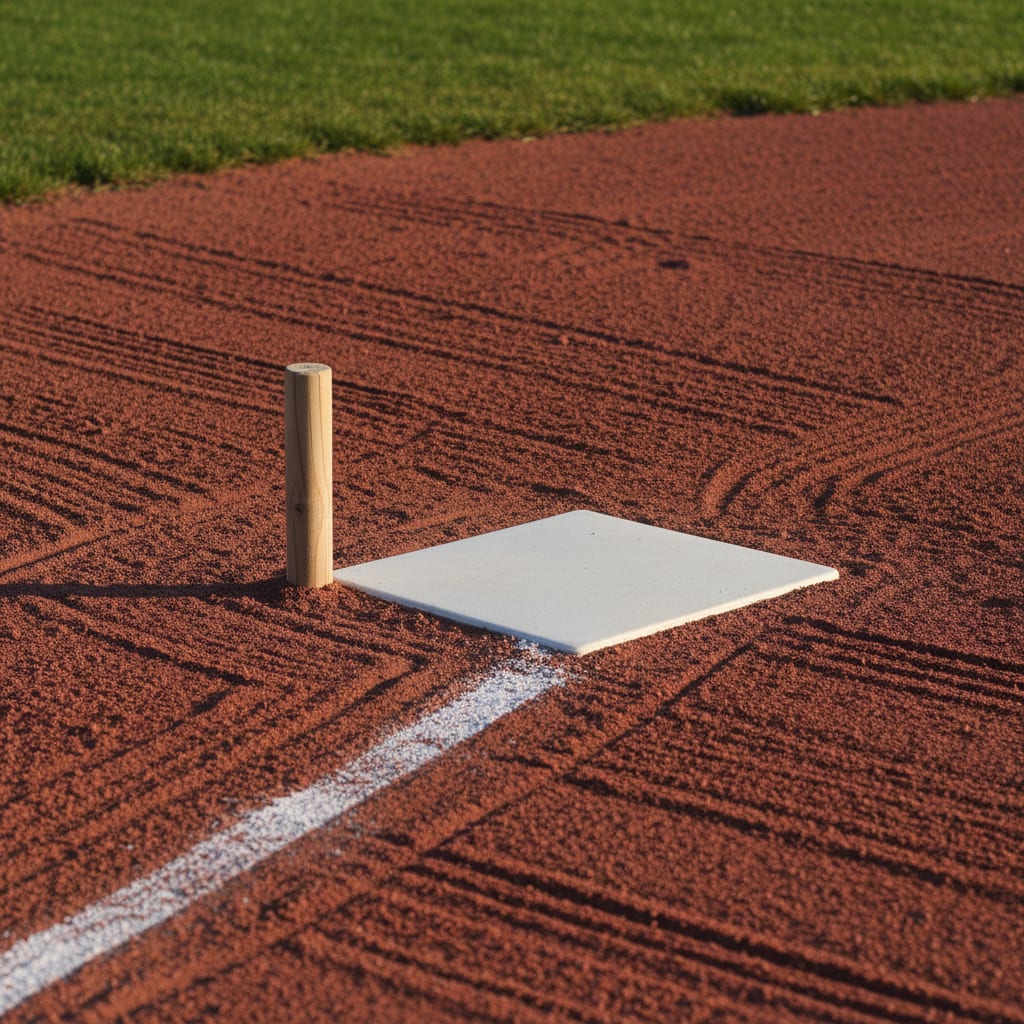
The backyard check for plate coverage: lay a flat stand-in for home plate on the grass. Have them stand so the end of the bat, held out, reaches the far side. Too close and they jam themselves; too far and they reach.
Step 3: dry swings
Little League’s tee ball plan has players practice “swinging without a bat (a dry swing)” while others take turns at the tee, and its coach-pitch plan lists dry swings before live hitting. In the yard, do five with no bat, then five with the bat and no ball, finishing with the bat around the body. Dry swings show you the swing without the distraction of results, and they show the kid that the swing is a thing in itself, not just a way to make contact.
Step 4: the tee
Set the ball at about belt height, out in front of the plate. Hit five, reset, hit five more. The point is a level, repeatable swing, not distance.
The worked example here is the tee already on our t-ball gear list, the Franklin Sports MLB Spring Swing No Tip Batting Tee. It lives outside and gets used.
Give the tee a target. A fence, a net or a big cardboard box on its side. “Hit it into the box” turns twenty swings into a game. Count out loud; numbers are the whole motivation system at this age.
Step 5: soft toss from the side
Once the tee swing looks the same every time, add a moving ball, but slowly. Kneel off to the side of the hitter and a little in front, out of the swing path, and toss a plastic ball underhand so it arrives in the hitting zone. The ball now moves, but only a little, and it comes from where the kid can already see it.
Use plastic balls in the yard. A WIFFLE set with two bats and six balls is the backyard standard, and plastic balls do not travel far enough to bother the neighbors.
Step 6: front toss
Now move in front, kneeling about fifteen feet away, and toss underhand toward the plate. This is the backyard version of what Little League’s coach-pitch plan does, where the coach throws “from knee” behind an L-shaped screen. Without a screen at home, keep to plastic balls and gentle underhand tosses.
This is where seeing the ball out of the hand matters. Little League’s week-four plan has a drill for it: the coach fakes a pitch while holding up fingers, and the hitter “has to call out the number of fingers the coach is holding up as soon as he sees them.” It works in the yard exactly as written, and kids love it.
The ten-minute session
- One minute of grip and stance. Knocking knuckles, bent knees, sideways.
- One minute of dry swings. Ten of them.
- Four minutes on the tee. Into the box, counting out loud.
- Three minutes of toss. Soft toss until it is easy, then front toss.
- One minute of the finger game. Then stop.
Stop while they still want more. That habit is in the ten-minute practice habit, and it matters more than any drill on this page.
What stalls a kid (all adult errors)
Pitching too soon. A kid who has not mastered the tee will learn to flinch at live pitching. Stay on the tee longer than feels necessary.
Too much bat. A bat that is too long or too heavy turns every swing into a fight. Our youth baseball bat size chart has the fit checks; a tee session is a good time to run them.
Coaching between every swing. One cue, then let them hit. Comments after every swing teach them to look at you, not the ball.
Making it about distance. A fence-buster off the tee is fun. A level swing that hits the box ten times is the actual skill.
FAQ: teaching a child to hit a baseball
What age should a kid start hitting off a tee?
Little League’s tee ball division is ages 4 to 7, and the tee is where its hitting starts. Many kids can begin dry swings and tee work at four or five. Its coach-pitch plans keep the tee in practice well past that.
How do I teach my kid to keep their eye on the ball?
Use Little League’s finger drill: fake a pitch while holding up fingers and have the hitter call out the number. It trains looking at the hand, which is where the ball comes from.
Should I pitch overhand to my kid?
Not at first. Go from tee to soft toss to underhand front toss, with plastic balls in the yard. Leave overhand pitching to the league and the coaches.
Which hand goes on top of the bat?
Little League’s tee ball plan says the throwing hand goes on top and the other hand below. A right-handed thrower has the right hand on top.
How long should a hitting practice be for a 6-year-old?
About ten minutes, three times a week. Short and frequent beats a long session that ends in tears.