Driveway Basketball: Hoop Height by Age + First Games
Set the hoop to the age, not to the driveway. The NBA and USA Basketball youth guidelines put ages 7–8 on an eight-foot rim, ages 9–11 on nine feet, and ages 12 and up on the regulation ten — and under-7s lower still, at whatever the bottom of your system reaches. That single number decides whether your kid develops a shooting form or a heave. A six-year-old firing at a ten-foot rim has exactly one way to get the ball up there: two hands, from the hip, launched with the whole body. That’s not a shot. That’s a habit you’ll be paying a coach to undo at eleven.
The height chart, and what each rung is for
The published USA Basketball youth guidelines set heights by age segment, and leagues vary around them, so check your rec league’s rules before you argue with anyone about it.
| Age | Rim height | What it’s teaching |
|---|---|---|
| 6 and under | 6 feet (or lowest available) | The ball goes in sometimes. That’s the entire curriculum. |
| 7–8 | 8 feet | One-hand release, elbow under the ball, feet involved |
| 9–11 | 9 feet | Range extension, shooting off the catch |
| 12+ | 10 feet | Regulation form, arc, contested shots |
The rule underneath the chart: a kid should be able to make a shot from a step or two outside the paint without changing their form to do it. If reaching the rim requires a shot-put motion, the rim is too high, regardless of what the birthday says. Kids grow at different rates and a chart doesn’t know your kid’s arms.
Going the other way matters too. A ten-year-old still on an eight-foot rim starts flattening their arc and losing interest, because everything goes in and nothing’s interesting. Move it up a foot when they’re bored, not when they’re twelve.
Portable, wall-mounted or in-ground: pick by adjustability
Adjustability is the whole decision at these ages, because you’re going to move the rim two or three times before high school.
Portable systems are the default for driveways, and the reason is simple: the telescoping post moves in increments, so one purchase covers the whole progression. The workhorse example is the Lifetime 1221 portable system with the 44-inch backboard — it adjusts from 7.5 to 10 feet in six-inch steps, and the base fills with sand or water so nothing gets bolted to your property. Six-inch steps matter more than they sound: half a foot is a real change to a nine-year-old, and being able to make small moves keeps you from over-correcting.
Wall or roof mounts are cheaper and permanent, which is the trade. If you mount one, mount it low enough for the kid you have now — you can’t move it later, and the family that mounted at ten feet for a seven-year-old has bought a decoration.
In-ground systems are the endgame: sturdiest, best rebound off the backboard, most expensive, and they involve concrete. Worth it when you have a twelve-year-old who’s still playing. Almost never worth it for a first-grader who might switch to swimming.
Two things I’d tell any parent shopping: backboard size drives how the ball comes off it (bigger and stiffer plays truer, and 44 inches is the honest floor for a driveway), and base weight is what stops a portable hoop wandering across the slab every time someone hangs on the rim. Fill the base full. Everyone under-fills the base.
What the setup actually needs beyond the hoop
Less than the store thinks.
- A right-sized ball. This is the second-most-common mistake after rim height, and it’s the same mistake: a ball too big forces a two-handed heave. Sizes by age — 27.5, 28.5 and 29.5 — are laid out in our youth basketball size guide, along with which one your kid’s league actually uses.
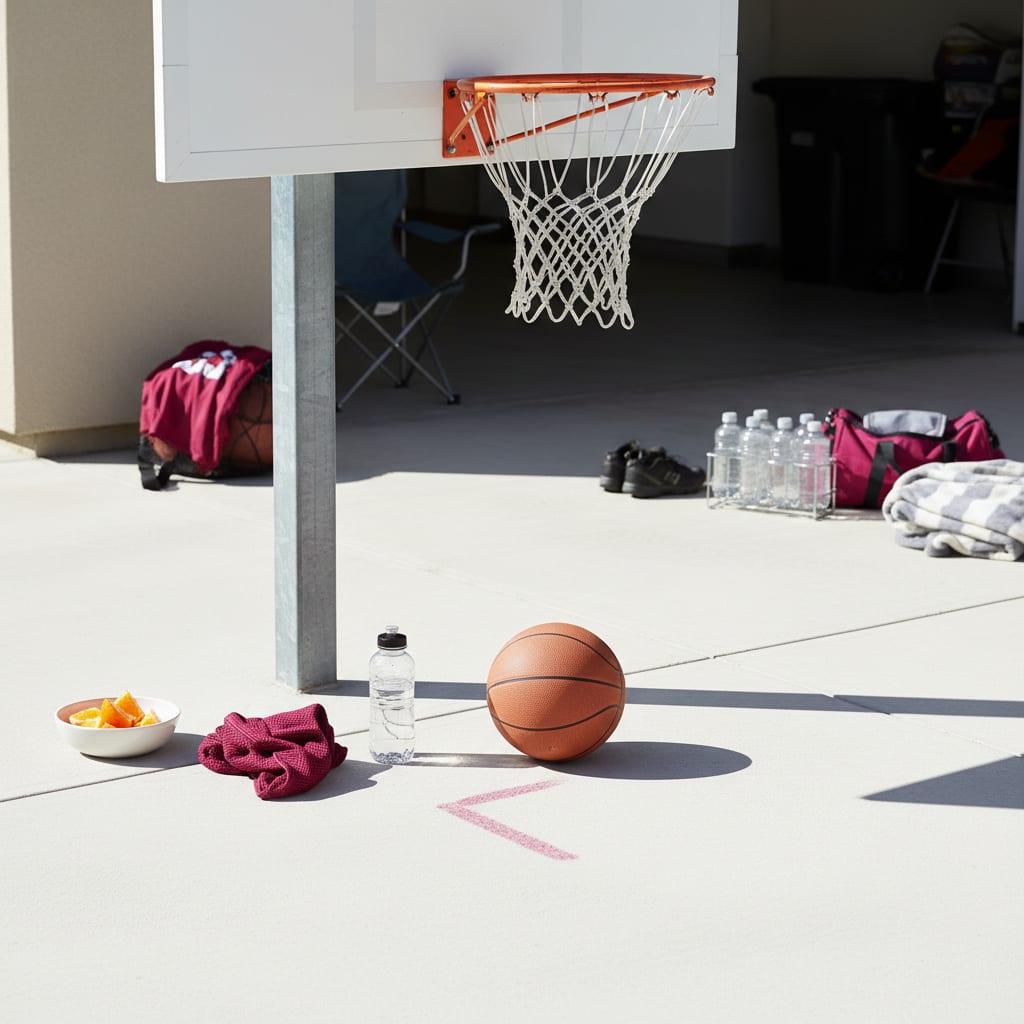
- A free-throw line you can see. Sidewalk chalk, or a strip of painter’s tape. Kids shoot from a defined spot far more willingly than from “somewhere around there.”
- Flat ground and a bit of run-off. A sloped driveway is playable; a sloped driveway that ends at a road is a different situation, and worth solving before it becomes one.
- Lights, eventually. Nothing extends a season like a porch light aimed at the right spot in November.
What you don’t need: a training ball, a shooting aid, a rebounder net, or a second ball. One kid, one ball, one line on the ground is a full setup.
Three games that make them shoot again tomorrow
Keep this short, because a driveway needs a menu, not a program.
- Around the World — five spots in an arc, make one to advance, back to the start on a miss. It teaches shooting from angles instead of one groove.
- Knockout — two or more players, front shooter has to make it before the shooter behind them does. Loud, fast, and it makes the free-throw line a place people want to stand.
- Beat the number — makes in a minute, tracked against yesterday. It’s the whole ten-minute practice habit in one game, and the number does all the motivating so you don’t have to.
When a game stops being enough, the next step is a short set of basketball drills for kids: the same six at every age, with a harder ask each year.
Your job during all three: rebounder and announcer, never coach. One technique cue per week, smuggled in as a rule change (“this round only counts if it hits the backboard”). If the driveway starts feeling like a practice, it stops being a place they go on their own — which was the entire point of putting a hoop there.
When to move the rim up
Signals, in the order they usually show up: they’re making shots from well outside their usual spots, they’ve stopped missing short, they’ve started dunking on a rim you set for a first-grader, and they say they’re bored. Any two of those and you go up six inches, not a foot. Expect their percentage to drop for a week and their interest to go up immediately — kids like a rim that’s slightly hard.
The one time to move it down: a kid whose form has gone two-handed and flat. That’s the rim telling you it’s too high, no matter what the age column says. Lower it, rebuild the shot, come back up in a month. Nobody at the rec league is checking.
Basketball is also one of the easiest first sports to run out of a driveway, which is part of why it shows up on our best sports for five-year-olds list — a hoop and a ball is a lower barrier than a team, a season and a registration window.
FAQ: basketball hoop height for kids
What height should a basketball hoop be for a 7-year-old?
Eight feet, per the NBA and USA Basketball youth guidelines for the 7–8 age segment. If your kid can’t reach eight without changing their shooting motion, go lower — form matters more than matching the chart exactly.
When should kids start using a 10-foot hoop?
Around age 12 under the published guidelines. The better test is whether they can shoot from outside the paint with normal one-handed form; if the ball is being launched from the chest with both hands, they’re not ready regardless of age.
Is a portable or in-ground hoop better for kids?
Portable, in most cases, because the adjustable post covers every rim height from the first-grade years to regulation. In-ground plays better and lasts longer, but it’s a commitment made before you know whether the kid stays with the sport.
How do I make a portable hoop stable?
Fill the base completely — sand is heavier than water and doesn’t need refilling. Most wobble complaints trace back to a half-full base, and no one thinks to check it after the first summer.
What size basketball does my kid need?
It depends on age and league. The short version, from the NBA and USA Basketball youth guidelines, is 27.5 inches at seven and eight, 28.5 from about nine (where girls stay), and 29.5 for boys from about twelve — the full breakdown is in our basketball size guide.
Can a kid practice basketball alone in the driveway?
Yes, and that’s the best argument for having a hoop at all. Solo shooting with a number to beat is one of the few youth-sports skills that genuinely improves without an adult standing there, which is why the rim height being right matters so much.